Share with your classmates:
Thomson High School APUSH
  • About
  • SUMMER 2016-2017 Assignment
  • Lectures and Notes
  • BLOG
  • Testing Resources
  • Syllabus and Rubrics
  • CONTACT MRS. PARTEN
  • Changes to APUSH Course 2015
  • US History Teacher Notes GA Standards
  • Reads and Flicks!
  • Resources 1972-2014
    • Questions and Vocabulary
    • Review Materials and Helpful Links
    • Fun Stuff

          BULLDOG BLOG

Summer Assignment
Over the summer, students will be required to participate in an online dialogue via my Bulldog Blog. This will be part of their summer assignment and count as part of their grade for APUSH this year. Specifics including the assignments and due dates will be posted as soon as possible.

Weekly Blog Assignments

Every week, students will be assigned a topic or topics to blog on based on the readings, lectures and assignments. These "Bulldog blogs" will count as Formative grades (aka: Quizzes) which average to 30 percent of your grade in the class.

Instructions for Questions:
For multiple questions: Initially respond to ONE question of your choice. By the due date for the blogging you will need to also respond to two of your peers who answered questions that you did not answer. For example, if you answered Question #1, you will respond to others who answered #2, #3 or #4.

For single question blogs: You will respond to the question and by the due date respond to two of your peers.

Instructions for Posts:
Your answer to one of the assigned questions must be a minimum of 15 sentences. You must answer the question completely for your initial response.

When responding to peers you must constructively argue why their answer is correct or incorrect, according to your historical viewpoint and the evidence you have been presented. Responses to peers must be a minimum of 10 sentences. ***Remember "I agree with you" and the like are NOT sentences.

Always cite evidence from your readings and the lectures in your responses.

PLEASE VISIT THE "SYLLABUS AND OTHER FORMS" Page for the Blogging Rubric!!!

THE  GREAT DEBATE - Gilded Age Blog                                   DUE Jan 14 - Midnight

12/31/2013

152 Comments

 
Picture
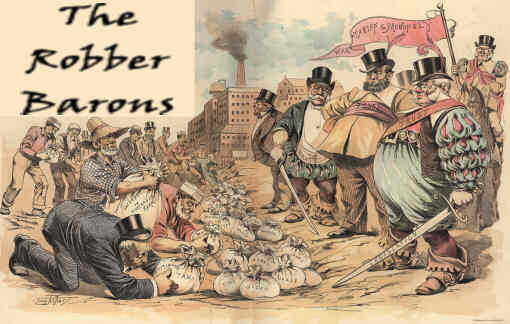
Should the industrial leaders of the late 19th century be referred to as ‘Captains of Industry’ or ‘Robber Barons?’
1) Choose a side/person for debate: labor union representative, farmer in the west, businessman from the list below:
John D. Rockefeller
Andrew Carnegie
Jay Gould
 J. P. Morgan
Henry Frick
Rev. Russell Conwell
James Hill
Leland Stanford
George Pullman
Levi Strauss
Herbert Spencer
Cornelius Vanderbilt
General Industrial Worker
General Western Farmer
Child Laborer
Railroad Worker
a Populist
Terence Powderly
Samuel Gompers
Mark Twain
Eugene Debs
Boss Tweed
George Washington Plunkitt
Ida Tarbell
Upton Sinclair
Frank Norris
Thomas Nast
Henry George
Edward Bellamy
*** If you choose a farmer, you may want to skim through Chapter 16 to get an idea of farmers in the west at the time.
2) Begin blog with this information: Your person’s name (you choose from the list above), person’s occupation, a picture of your person, and a quote that summarizes their business and/or personal philosophy (if you are a laborer, farmer, etc. who would not typically have a business philosophy, write a quote about a major grievance you have).
3) Answer the following question in a paragraph or two (10-20 sentences):  (this should be on the same blog comment as the information above, but separated by a couple of lines) -- “Should the industrial leaders of the late 19th century be referred to as ‘Captains of Industry’ or ‘Robber Barons?’”
4) Respond to at least two other people on the blog– one that you agree with and one that you do not agree with.    
152 Comments
Samuel Robinson (Mark Twain)
1/1/2014 06:07:49 am

Mark Twain (Samuel Langhorne Clemons)
Author/Writer
"Apparently there is nothing that cannot happen today"
http://ts4.mm.bing.net/th?id=H.4906249742648019&w=136&h=147&c=7&rs=1&pid=1.7


The leaders of this 19th century industry are obviously "Robber Barons." In this industry, robbing people is the only way to ensure your own victory. For example, as an author I will be cut short of my deserved profits by the industry middle man. However, the idea of being a captain of industry seems to be a title with little meaning. A captain of industry is a captain of deception and robbery. I see no different in these denominations Until the day a man of industry can fairly rise to his position, titles will be created to commemorate their deceptive accomplishments. However, I do believe it is possible to accomplish this. There must be, in some way, a solution in which a man can honestly climb the proverbial ladder of industry. Each rung of this ladder can be represented as a step toward a Captain of Industry, or a Robber Baron. The day that this occurs, the American industry will become an honest an reliable system.

Reply
Riley McBride
1/8/2014 12:42:34 am

I understand that being a "robber baron" was the easiest way to gain wealth; however, it wasn't the only way to ensure victory. For example, Andrew Carnegie started off as a boy in a poor family. His first job was changing the spools of thread in production. He received little money and what he did get he had to donate to his family. He worked his way into the industry until one day he did finally make it as a wealthy man. Then he did become a Captain of Industry as he gained more and more money until the Robber Baron known as J.P. Morgan overtook his industry with his own. I do agree with you that the American system with become reliable when these labels disappear. Those who worked very hard are often the ones that are cheated. This never allowed those with no money the opportunity to gain wealth or move social status.

Reply
Jayla Smith
1/8/2014 07:39:35 am

I understand your point of the industrial leaders being robber barons because of the time period. However, Cornelius Vanderbilt did reach half of his accomplishments the old fashion way. He started a job at the bottom and worked the same job until he managed or owned the entire production. Some things were not his own to claim, but for the most part, he started everything his name now claims. Vanderbilt was not greedy for money. He was simply determined to do better than his parents had and reach success. Not everyone in this time period had to steal ideas to be successful and make money. My reasoning for my proposition is backed up by researched. Every successful person in the time period did not steal someone's invention or become desperate for money. Cornelius Vanderbilt is proof of what a hard working, successful man was in this time period. He and some others deserve to have the name Captain of industry. If you were living and had achieved success the old fashion way among a bunch of thieves, you would rather them have a good name along with yours than to have your name dragged in mud along with theirs.

Reply
Brooke Cunningham
1/8/2014 09:48:52 am

Although farmers felt the industry was robbing them of their way of life, in Actuality it was just a change in their comfort. Industry brought a faster and more efficient way for the north while also changing the souths system. Although southerners may feel captains of industry robbed them, they were only trying to succeed too. Farmers can still make a way of life in producing but it must be in a different manner. Any change without a sudden solution is a problem but it can be fixed. Sometimes thinking outside the box leads to the greatest discoveries and that is where I agree with you. The industry is already a trust-worthy system. For example building a tractor to pick cotton will incorporate the industry with farming, someone to build the tractor and someone to use it, which both will profit from. With industry we can grow and support more. Time's are changing and some things will have to change.

Reply
Deedric Mitchell
1/14/2014 06:57:20 am

This is a great overview of how a farmer would percieve them. I love the fact that you stated that the farmers felt as if they where being robbed of their way of life. However, I think that is because they where imposing a new culture that was foreign to them. You had very good examples of why they should be classified as a robber baron. Also, when you compared and contrasted the differnce between why the farmers thought they was and what they actually was doing for their society it really cleared some things up for me. Great summary I really enjoyed reading it.

Leannah Hicks
1/10/2014 01:56:12 am

This is a fantastic analysis on the point of veiw of Mark Twain. I, myself can see him standing up for those men that worked hard to get to the place they were fort nothing else than to be critisied for the job they have and pushing others towards their full potintail. Also I agree completely with your ending statement of, "The day that this occurs, the American industry will become an honest and reliable system." this saying I think covers the bases of what could be the opinion of all captains of industry, or a Robber Baron on the matter.

Reply
Adam Murphy
1/12/2014 08:03:58 am

I understand your views of the leaders of the 19th century being "Robber Barons" but I cannot agree with you. Many of this leaders avidly gave back to the communities that allowed them to reach the heights that they had. John D. Rockefeller was the founder of one of the biggest corporations of the 19th century, Standard Oil Company. He also founded the Rockefeller Foundation. This foundation helped create places like John Hopkins School of Hygiene and Public Health. Rockefeller personally gave $250 million to this foundation. Rockefeller also rose to the top honestly. He began as bookkeeper and when he saved up enough money, he went into partnership and bought an oil refinery. This oil refinery was the beginning of the great company of Standard Oil. These leaders might have been viewed as crooks but as many say "It's just business".

Reply
Deedric Mitchell
1/14/2014 07:09:46 am

This is a great article I agree with it completly. I to felt as if the leaders where indeed "Captains if Industry". As you see what all they have done for America you have no choice but to classify them as that. As you have perfectly stated as a example when Rockerfeller started his foundation. In order for him to give money back to his people he had to earn it. Thus starting his factories and gaining and earning money.His factories may or may not have been the best but still he made a way for his people. I totally loved this article I think you did a great job. I enjoyed reading it.

Lee Roland
1/13/2014 07:41:25 am

Although I agree that some leaders were Robber Barons of this country, I must disagree that not all leaders or "Industrialists" were Robber Barons but simply were Captains of Industry. Men like John D. Rockefeller, Cornelius Vanderbilt, and Andrew Carnegie helped America establish great industries such as oil, rail, steel, shipping, and finance. You might think they did so through corruption and stealing ways but no, these men were truly Captains of Industry. These men were not selfish in how they used their money. John D. Rockefellar was well-known for his philanthropic uses. Also Cornelius Vanderbilt and Andrew Carnegie both started from the bottom and worked their way up the so called hierarchy ladder. They worked for their wealth and growth in the industrial business. So that is why i do not agree with the American industry being brought up by Robber Barons.

Reply
Jada Orr
1/14/2014 05:40:33 am

I agree that some people during this time period could be listed as a "robber baron" and I also agree that it was an easier way to be victorious. However, I would have to say that it wasn't always successful. When being a robber baron, you have to depend on others for success where as if you were a Captain of Industry, you would depend on yourself for the country's success. Examples of Captains of Industry would be J.P. Morgan, Andrew Carnegie, Andrew W. Mellon, and John D. Rockefeller. John D. Rockefeller founded oil which helped the country's wealth during the industrial revolution.

Reply
Keosha Harris
1/14/2014 09:15:07 am

Speaking as Morgan: I see where you are coming from when you said there are 19 century Robber Barons. It indeed did. There's only one thing though. Not all of the businessmen where just Robber Barons. Some as myself as well was known as both a Robber Baron and Captain of Industry. You should have said more about yourself, "Mark Twain" and how you was a Robber Baron. You really did not give enough evidence to why you thought the 19 century leaders were mainly Robber Barons.

Reply
Whiddon Henry
1/15/2014 10:08:19 am

Im going to have to disagree with you. The leaders of the 19th century are Captains of Industry, not robber barons. They worked hard to make their fortune and the work paid off. They may have had to crush a few people to get to the top but that is capitalism. If you dont like it, move to a communist nation. These captains of industry took the American dream and made it a reality. They progressed society with their industrial advancements and charity work. Most of these men were decent hard working individuals who helped create an industrial empire.

Reply
wendy lashquain
11/1/2014 04:31:09 am

IIIIIIIIIIIIIIIIIIIIIIIIIIIIIIIIIIIIIIIIIIIIIIIIIIIIIIIIIIIIIIIIIIIIIIIIIIIIIIIIIIIIIIIIIIIIIIIIIIIIIIIIIIIIIIIIIIIIIIIIIIIIIIIIIIIIIIIIIIIIIIIIIIIIIIIIIIIIIIIIIIIIIIIIIIIIIIIIIIIIIIIIIIIIIIIIIIIIIIIIIIIIIIIIIIIIIIIIIIIIIIIIIIIIIIIIIIIIIIIIIIIIIIIIIIIIIIIIIIIIIIIIIIIIIIIIIIIIIIIIIIIIIIIIIIIIIIIIIIIIIIIIIIIIIIIIIIIIIIIIIIIIIIIIIIIIIIIIIIIIIIIIIIIIIIIIIIIIIIIIIIIIIIIIIIIIIIIIIIIIIIIIIIIIIIIIIIIIIIIIIIIIIIIIIIIIIIIIIIIIIIIIIIIIIIIIIIIIIIIIIIIIIIIIIIIIIIIIIIIIIIIIIIIIIIIIIIIIIIIIIIIIIIIIIIIIIIIIIIIIIIIIIIIIIIIIIIIIIIIIIIIIIIIIIIIIIIIIIIIIIIIIIIIIIIIIIIIIIIIIIIIIIIIIIIIIIIIIIIIIIIIIIIIIIIIIIIIIIIIIIIIIIIIIIIIIIIIIIIIIIIIIIIIIIIIIIIIIIIIIIIIIIIIIIIIIIIIIIIIIIIIIIIIIIIIIIIIIIIIIIIIIIIIIIIIIIIIIIIIIIIIIIIIIIIIIIIIIIIIIIIIIIIIIIIIIIIIIIIIIIIIIIIIIIIIIIIIIIIIIIIIIIIIIIIIIIIIIIIIIIIIIII

Reply
Samuel Robinson
1/1/2014 06:16:14 am

Reply
Amy Nelson
1/6/2014 03:53:12 am

John D. Rockefeller has become one of the most notoriously know business men, because of his co-founding of the Standard Oil Company. The Standard Oil Company has become one of the most successful and know industry in American History, and also has revolutionized the American petroleum business. A quote by Rockefeller himself, “Do you know the only thing that gives me pleasure? It's to see my dividends coming in.” This quote reflects on Rockefeller’s obsession with money and earthy possessions. Another quote that reflects his opinion on life is, “The world is made up of two kinds of people. Those who are too incompetent to make do with what they have been given, and then there are those like me who will strive and preserve until the have succeeded so thoroughly that the remains no humanly possible way to fail.”


At the beginning of the 19th century, America was expanding and continuing its course of industrialization. With the increasing of buisnesses, factories, and industries, many individuals began to climb the social ladder, while others continuously dropped to the bottom. With the increased division of social classes, robbing and corruption began, and so then the Gilded Ages also. Therefore, the term “Robber Baron” effectively characterizes the industrial leaders rising to power through injustices and robberies. “Robber Baron” is defined as industrialists that use unlawful and unethical practices, such as lying and/or cheating, to continue to profit. In this time period, there were very few labor laws, and or other rules, emplaced to protect the common work. Now in present day, there are Child Labor Laws, and 40 hour Weekly Limits in effect in most countries to prevent overworking. However, in the late 19th century there were not. Since they were not limits to how many hours and there was no “minimum wage”, these Robber Baron´s could produce products at very low prices. These low prices made other business resort to the same injustice; however, most business men had no empathy for their suffering workers. The industrial leaders were merely thirsty for money, and hungry for power. Industrial leaders have also been characterized as “Captains of Industry”. “Captains of Industry” is used to describe the rich business individuals that use their money and newly gained wealth to benefit their country. This obviously does not parallel the pigs in the United States, because they did not in any way contribute to the country´s growth. They did the opposite, the increased the social gap between the rich and the poor, and by this causing more resentment among the two. Also by the low wages and the long hours, they made it impossible for a mere factory work to study and raise social position.


(I couldnt figure out how to paste the picture)

Reply
Riley McBride
1/8/2014 12:22:43 am

I chose the term "robber baron" to describe the industrial leaders and agricultural leaders in America and I understand and agree with your claim because those who were leaders in the industry cheated their way through the economy to gain wealth. Like you said, the long hours and little pay was just one of the many examples of how the leaders cheated. They not only cheated the system in the economy but they cheated the factory workers. I can also understand how you think they were "captains of Industry" as well. The industrial leaders did all they could to get more and more money. There was never enough money and wealth in their opinion. J.P. Morgan was a financier and banker and he said, "If you have to ask how much it costs, you can't afford it." which showed the difference between the wealthy leaders and poor middle and low classes.

Reply
Tequa Johnson
1/15/2014 10:36:49 am

I like your reasoning and argument, but unfortunately I disagree. You can't base your decision to call them robber barons because of one person. Although some industrial leaders did cheat the system and workers, I feel it only defines a true captain. It was their duty to lead and that's what they did. J.P. Morgan was a man that can truly be considered to be a robber baron, but even though he cheated his way to the top, he did give back. Morgan and others such as Carnegie strengthened the success of America then and continues to play a role.

Breana Box
1/9/2014 06:38:01 am

Although your argument is strong, I do not consider the industrialists of the 19th century as Robber Barons. As you mentioned, a Robber Baron is seen as a cruel and self-centered entrepreneur who abused his social status to gain wealth. However, some industrialists, such as Henry Frick, contributed greatly to the economy of the United States and should be labeled as Captains of Industry. For example, Henry Frick founded the H.C. Frick Coke Company and was also a part of the Carnegie Steel Company and U.S. Steel businesses. These businesses greatly contributed to the economy because railroad, steel, and iron industries relied on these companies to fulfill their iron and steel needs to build railroads and further transportation construction projects. His efforts did reward him, financially; however, Henry Frick participated in philanthropic activities, such as donating his personal art collection to form the Frick Collection and Art Museum. Even though industrialists benefitted greatly from their industries, the nation also economically prospered. Therefore, the industrialists of the 19th century should be considered Captains of Industry.

Reply
Samuel Robinson
1/9/2014 07:29:15 am

I agree with your statements on the robber barons of the industrialist 19th century. Corruption and robbery is praised as a crime of the highest caliber. However these laws and rules seem to apply only to those who are of low social status. These "big shots" of the 19th century completely abuse the system that we are all a part of. Why praise these actions by the wealthy, but punish the poor who act on these in an attempt to become one of these Robber Barons.

Reply
Mackenzie Snyder
1/12/2014 06:39:39 am

Even though you have a strong argument, I do not agree with you that industrial leaders were "Robber Barons". The 19th century industrial leaders were "Captains of Industry" because many of them worked hard to be successful and gave back to the country. Their success even strengthened the American economy. Andrew Carnegie introduced the Bessemer Steel making process to the U.S., which allowed for a mass production of steel. The mass production of steel allowed for many railroads and bridges to be built for the American citizens. Andrew Carnegie worked hard to be a leader in the steel industry because he lived in poverty as a younger boy. Andrew Carnegie was able to climb the social ladder because he started as a "bobbin boy" in a cotton mill with a weekly salary of $1.20, then became a manager of the Pennsylvania Railroad Company, and finally created the Carnegie Steel Company. The creation of the Carnegie Steel Company allowed for many jobs to be available for Americans. The Carnegie Steel Company was eventually sold to the United States Steel Corporation, which allowed for even more jobs to be created. The creation of the United States Steel Corporation also benefitted Americans because with the money Andrew Carnegie received from selling his company he gave back to the country. Andrew Carnegie spent about $350 million by building over 2,500 public libraries, opening the Carnegie-Mellon University, and establishing various charitable organizations.

Reply
Zakirra Mckinnon
1/12/2014 09:22:46 am

Your counter argument is very strong and makes excellent points, however I would not consider all the men and women of the late 19c to be Robber Barons. Robber Barons were only seeking wealth for their own benefits. Although, Not all were seeking wealth but some truly were seeking to improve the nation. I would say they were "Captains of Industry" because many worked from the ground up to live a successful life and to try and help create such a life for other, schools and Temples were built to help improve the lives. Majority helped inspire and build the Nation up without even being concerned about being wealthy and the money that was earned was given back to help build the Nation up even more. However, Rev. Russell Conwell is an excellent example of a Captain of Industry. He ministered to the people of Philadelphia and even inspired the people to build a temple. For the few who were Robber Barons one can not allow them to ruin the name of those who did so much to build and improve the Nation.

Reply
Tavon
1/14/2014 08:57:14 am

When you said robber barons are industrialists, I had to disagree. Although some industrialists were characterized as robber barons, they had to be considered as captains of industry also. Think of all the economic growth and stimulation they caused. Yes maybe their profiting ways may have been a little cruel, but these industrialists were helping the economy. They were increasing the US money and worth. They also lowered the unemployment rate. The industrialists would hire many workers to work in factories. Wealthy landowners would also have many workers through the crop-lien system. It would also be these industrialists' industries that aided the US in the world wars. Even though the industrialists ways of making money were not the best, they were the most beneficial to the country.

Reply
Riley McBride
1/8/2014 12:13:52 am

J.P Morgan was a powerful financier and banker through the late 19th and 20th centuries. He was given the opportunity to help save businesses as well as the government. He formed many small companies into large corporations to gain wealth. When the government did not have enough money, they would rely on J.P. Morgan and other large bankers to help with costs in exchange for bonds. Morgan was very persistent in all things he did. He said, "Well, I don't know as I want a lawyer to tell me what I cannot do. I hire him to tell how to do what I want to do." This shows how he gained his wealth and let nothing stop him in his path.


During the late 19th century, industrialization was going strong in many parts of America. Although this was a great source of wealth for many, those who worked in the factories were not given a shot at becoming more than factory workers. The owners of the factories squeezed as many people in the buildings to ensure that production was at its highest. These people were considered "robber barons" because they often cheated those in the middle and low classes who were working hard in the industrial side of the economy. The wages for factory workers were low and the hours were long so the owners could get production with minimal pay. Factory workers were forced to live in the homes near the factory which forced them to give up most of their money to paying for the home and for everyday needs such as food. This left little to no money left over for the worker. The wealthy leaders in the agricultural side of the economy were also considered "robber barons". Crop-lient systems allowed small farmers to use the land of large plantation owners in order to pay off a debt. This did not work in favor of the small farmer because the amount they had to give up left only a small amount to support the family. Extra money could not be saved to get out of this because extra money was never given by those who owned the large plantations.

Reply
Riley McBride
1/8/2014 12:26:48 am

I couldn't figure out how to get a picture.

Reply
Riley McBride
1/9/2014 07:49:24 am

J.P. Morgan
Financier and Banker
"Well, I don't know as I want a lawyer to tell me what I cannot do. I hire him to tell me what I want to do"
http://deephighlands.files.wordpress.com/2012/03/jp-morgan-born-april-17-1837-died-march-31-1913.jpg

Reply
Amy Nelson
1/11/2014 05:26:32 am

I strongly agree with your claim that the industrial leaders of the centuries were ¨"Robber Barons". Like you stated, although many did prosper, such as the leaders and the higher class, the lower class suffered oppression. The lower class also had little to no oppurtunity to move up the social chain. Among with the poor remaining lower class, the did, as you mention, worked inhuman hours and and in unsafe conditions. The poor were payed such little wages that they had little oppurtinuty to even buy a "luxury" such as meat. In conclusion, this argument was a strong and valid argument effectivly portraying the selfishness of the "Robber Barons" in the late 19th century.

Reply
Alexandra Holt
1/13/2014 07:46:47 am

I completely agree with your statements above. J.P. Morgan was a "robber baron" like many others during the 19th century. I liked how you said that in the farming industry some were considered "robber barons" too. J.P. Morgan was like many other industrialists then, for example, John D. Rockefeller. They both did everything they could do to gain money and not lose it. They did it by like you said, by taking it out on the laborers who worked for them. This caused a huge division between the rich and poor.

Reply
Jada Orr
1/14/2014 06:07:53 am

I agree with you when you say that J.P. Morgan was a robber barron. Robber barrons use power to gain their own wealth instead of the country's. These people that worked in the factories worked all day and night with little to no pay. Robber barrons made the division between the rich and the poor spread more and more. The rich got richer, and the poor got poorer just by the simple fact that the poor people worked hard all day, but the wealthy people received the pay.

Reply
Tavon
1/14/2014 08:35:46 am

I agree with your description of "robber barons". During the late 19th century, robber barons were considered bad people to the middle class and poor. These robber barons made their money off of the middle class, and didn't care about it. The robber barons owned major industries and factories. They would hire many workers and pay them tiny wages. The wages were barely enough to live off of. The only real favor the robber barons did for the middle class was give them jobs. That may sound good, but these jobs were in bad working conditions, low paying, and sometimes tore apart families depending on where the job was. Wealthy landowners were also on the robber barons side. I agree. Wealthy landowners of course would make a profit off of their workers. These landowners would cheat the workers out of some of their pay to increase their own profit. This enables wealthy landowners to be classified as robber barons.

Reply
Brooke McAllister
1/14/2014 09:12:24 am

I agree with your choice of robber barons. Although JP Morgan may have had some good intentions in gaining wealth, he used the lower and middle class to gain wealth. During this era, the wealthy would use their power to manipulate the poor. By manipulating them, they robbed them not only of money but of their rights as well!

Reply
Jayla Smith
1/8/2014 07:30:28 am

Jayla
Cornelius Vanderbilt: Pioneer American Industrialist
Picture:http://upload.wikimedia.org/wikipedia/commons/thumb/5/57/Cornelius_Vanderbilt_Daguerrotype2.jpg/250px-Cornelius_Vanderbilt_Daguerrotype2.jpg

QUOTE: “I don’t care half so much about making money as I do about making my point, and coming out ahead.”

Speaking as Cornelius Vanderbilt, industrial leaders should be considered Captains of Industry. Not everyone with the title just wanted wealth. Some loved what they did or just wanted to provide more than what their parents did. Robbers Barons are the industrial leaders that would do anything for money including stealing ideas or getting paid off of someone else’s invention. However, I do not consider myself as such a person. I started from the bottom of the industrial chain. Each time I mastered a job, it was because I deserved to do so. Even though some industrial leaders should not get the name as Captains of Industry, most should. Everyone should not have to suffer a bad name because a few decided they just wanted to be greedy. Speaking for my good name, industrial leaders should be considered as Captains of Industry. Captains of Industry are the people who reached success out of merely working hard. Most did not have a rich background, so the young leaders were determined to reach a higher success than their parents had. Overall, the industrial leaders should be considered captains of industry because not all were just looking for wealth or an idea to steal. Some actually worked hard to get to the point.

Reply
Brooke Cunningham
1/8/2014 10:03:22 am

I agree with you. It is unfair to label everyone based off a few. Most people were trying to gain success and better themselves. They did not have the intention of crushing others. Those who have been dishonest may be labeled as robber barrons but for the rest, captains of industry. John D. Rockefeller gave to many people and charities such as yourself. Just as the industry workers have had to work hard , farmers will have to work even harder to make a change and get back on top. It is easy to blame others when life isn't working out. the only solution is to think differently and embrace change. Complaining will not change anything, only hard work.

Reply
Breana Box
1/9/2014 06:34:49 am

I agree with your reasoning as to why industrialists of the 19th century should be considered Captains of Industry. In the stereotypical 19th century society, most men that worked their way to wealth and success were seen as cruel, bitter men that had no regard for anyone but himself. Envious Americans labeled these prosperous men as Robber Barons. According to their point of view, industrialists were the entrepreneurs that took advantage of factory workers, who worked in harsh conditions and received low pay. Although most factory workers did experience these conditions, the workers chose to work in factories to provide for themselves and their families. I like how you mentioned that most industrialists, including Cornelius Vanderbilt, started out as workers but pursued a career in what the men enjoyed doing. These men developed their own businesses and careers to better their lives, as well as, the lives of their fellow Americans. The industries created by the industrialists were frequently in high demand, such as iron and steel. Therefore, industrialists of the 19th century, such as Henry Frick and Cornelius Vanderbilt, used their management skills to create businesses and lead the nation to a stronger economy as Captains of Industry.

Reply
Samuel Robinson
1/9/2014 07:12:49 am

Unfortunately, I agree with the process in which you claimed your life of wealth. You mastered skills and used them to the best of your abilities in an environment were stealing would be preferred. I am not saying the these Robber Barons had a lack of intelligence and resorted to theft, but their actions are not worthy of the praise in which they receive.

Reply
Leannah Hicks
1/9/2014 09:58:01 am

I see what you mean and what the point is that you are getting across. I agree with the way you show that Vanderbilt would defined himself from the criticism that the workers in the union groups and others that see him as a "Robbers Barons". You do a fantastic job at establishing how Vanderbilt, unlike other leaders of industrialization, had to work his way to the top of the food change if you will. Mr. Cornelius had to go through ups and downs to get where he was and if he was criticized for get on top by using others works I, myself do believe he would defended himself in a very similar manor as you did here.

Reply
Amy Nelson
1/11/2014 05:35:53 am

This comment does not effectivly reflect the majority of the industrial leaders in the 19th century. Yes inturn, some leaders were generous and kind and wanted to improve the nation, however that percentage is a small miniscule number. Most were power and money thirsty. Yes, Cornelius Vanderbilt in turn did fight and work his way up to the top, however he was one of the few. When classifying groups in turn the classification must effectivly classifying the mayority of the population. Therefore, the capitalist of the late 19th century are more effectivly classified as "Robber Barons". (Sorry this computer does not have spell check in English.)

Reply
Mackenzie Snyder
1/12/2014 04:58:44 am

I agree with your claim that most of the industrial leaders should be viewed as Captains of Industry. It's not fair that some greedy industrial leaders coined all of the industrial leaders as "Robber Barons". I love how you mentioned you started from the bottom of the chain and worked your way to the top, which is very similar to Andrew Carnegie. Andrew Carnegie as a young boy lived in poverty and had to watch his father beg for jobs, so he vowed when he grew older he would become successful. Andrew Carnegie worked hard and had no intent of harming others to get to the top of the steel industry. These industrial leaders strengthened the American economy. The opening of factories gave many Americans jobs, which allowed them to support their families. Many of the industrial leaders even gave back to society. Many donated their money to charities or to organizations that would improve mankind with the building of libraries and schools. American citizens could then benefit by bettering themselves with educations.

Reply
Adam Murphy
1/12/2014 08:13:40 am

You make a very strong counter argument about Robber Barons. Not everybody at the top is in it for the money. Many give back to those who helped them. Also you can't let one bad fruit ruin the entire harvest. Not all leaders were "Captains of Industry" and not all were "Robber Barons". People like Cornelius Vanderbilt are good examples of those leaders who were "Captains of Industry". John D. Rockefeller is another good example. He gave a tenth of every paycheck he made to his church. He founded the Rockefeller Foundation. He personally gave $250 million to this foundation. He also rose to the top very honestly without damaging the lives of people around him.

Reply
dnaye
1/14/2014 12:58:19 pm

although Rockefeller did all these things, such as donating to charities, and founding these programs,he received the money to do that in bad ways. People are not only judged on the good things that do, but also the bad. he stole peoples' land to expand in his business ventures and get ahead in life. He also had a lot of factories where he underpaid and overworked his laborers So, while he is a captain of industry, he resembled a lot of characteristics of a Robber Baron.

Kameron Watson
1/13/2014 08:36:59 am

I completely agree with your statement because you are right in the fact that not all wealthy businessmen were greedy people. In fact, numerous businessmen should be 'Captains of Industry' rather than 'Robber Barons,' as you stated. Many of the wealthy people did start from the bottom and work their way to the top, as you said. For example, the textbook states that there were "self-made men" such as Andrew Carnegie, John D. Rockefeller, and E. H. Harriman. Regarding Cornelius Vanderbilt, he would certainly be considered "self-made" because he grew up helping his father operate a ferry boat. I completely agree with you about the fact that "Everyone should not have to suffer a bad name because a few decided they just wanted to be greedy." I do not think should all rich industrialists should be punished because of a few bad apples. For example, Andrew Carnegie was immensely wealthy, but he was a very good man. He had a complete "rags to riches" story. Also, he was huge in philanthropy activity. He even wrote a book called "The Gospel of Wealth," which explained how wealthy people should put their money to good use to benefit the community. Therefore, I think most wealthy businessmen should be considered or referred to as 'Captains of Industry' because they greatly helped in making industry in America prosper. There may have been a few ruthless 'Robber Barons,' but not all men who grew up poor or became philanthropists should have to suffer that title, as you stated.

Reply
Addison Archer
1/14/2014 02:28:08 am

I agree with your statement on Cornelius Vanderbilt. He is considered very much as a Captain of industry. He didn’t care just about wealth, he cared about bettering others. As he said in his quote, “I don’t care half so much about making money as I do about making my point...” It obviously shows that he doesn’t just care about getting money. He didn’t grow up with lots of money, so he worked for what he eventually received.

Reply
John Eager
1/14/2014 08:28:58 am

I totally agree with your assessment. So many great industrial leaders were stereotyped as greedy and ruthless men. What so many people failed to see was that many of these wealthy industrial leaders came from poor and humble backgrounds.The main room of Andrew Carnegie's childhood home served as a living room, dining room, and a bedroom. He would later dominate the American steel industry but he always gave back to the less privileged people. Most of these industrial leaders were at the bottom of a workforce, but because they worked hard and made wise decisions they were very successful industrial leaders. As you pointed out, most of the industrial leaders of this time period should be referred to as "Captains of Industry" because they were charitable men who fairly earned all of their money, and they revolutionized the industries in America.

Reply
Morgan Perry
1/14/2014 10:14:20 am

I feel the same way you do. You make an excellent point. Your right not all wealthy people pulled teeth to get in their postion some of them it just came to. I like how you included that the captions of indurty actually put in effort and worked hard. John D Rockefeller was a person who took other companies down ass he developed, but there is another side to him like you emplyed. Rockefeller allowed his former compitions to become partners in his new buisness. Most people do just come off as the shallow greedy captions of indusrty, but yet they all have their story that can develop them in to a good person. I like how you included the sentence about Robbers and Barons. Your correct they are just nasty people. They arent the ones to get a second chance, they are stuck with the bad name.

Reply
Keosha Harris
1/14/2014 10:54:02 am

Speaking as J.P Morgan: I see where you are aiming for. Not all industrial leaders were classified as Captains of Industry. Like I have said before us industrial leaders was not just Captains of Industry. Some of us were Captains of Industry and Robber Barons. Just because you came up as a Captain of Industry does not mean you was not also a Robber Baron. I agree with you when you said," Captains of Industry are people who reached success out of merely working hard". You right about who Captains of Industry are. I agree with you on that.

Reply
Tim McClain
1/14/2014 01:01:32 pm

I agree with your accusation. Its true that you can't judge a few off the many. To gain success & better themselves were the industrial leaders goals. They weren't basing their work on hurting others. Rockefeller was a huge peoples person. And you showed that he was a Captain of Industry.

Reply
Tequa
1/15/2014 07:22:34 am

I agree with you and your reasoning. A group shouldn't be classified by one name because of a few people in that group committed wrongdoing. Many others who are really Captains of Industry started at the bottom and worked their way to the top such as Andrew Carnegie. After seeing his family struggle, he decided that that wasn't the life for him. After selling his steel mill for $ 480 million, Carnegie had already given $350 million to public libraries and other institutions, which defines a Captain of Industry.

Reply
Brooke Cunningham
1/8/2014 09:33:20 am

John D. Rockefeller
co-founder of Standard Oil Company and Philanthropist
http://upload.wikimedia.org/wikipedia/commons/6/6f/John_D._Rockefeller_1885.jpg
"If you want to succeed you should strike out on new paths, rather than travel the worn paths of accepted success"

As a business man, I understand the controversy between agrarian society vs. industrialization. Although change is scary, it is a necessary evil. The agrarian lifestyle is failing and is not a way of life for such a growing country. Together we need to explore the advantages and disadvantages of industry and shine light on the profitability of a growing industry. Instead of discouraging and belittling CEOs and business men of industry we should encourage them as "Captains of industry", for they are the future of our country.The secret of success is attention to detail. Let us learn from those who are successful. Although agrarian society has been ongoing it is now not enough and we must proceed diligently with fore-thought, plans, and much precision. I think as our country continues to grow there is a place, perhaps even farming but in a more elaborate and efficient manner. I, John D. Rockefeller, wish to move this country forward not only with my personal industry but along with helping others who wish to succeed.

Reply
Morgan Perry
1/14/2014 10:21:05 am

I had John D Rockefeller as well. I got the same "helping others" vibe from himas well. He is a good true Caption of Industry. I really understand where your coming from in your comment. You made it sound it true and not sugar coated, very good. I totally agree with what you saaid about people just needing to face the facts. They must accept that the world is changing. Dewelling in the past will make them the greedy captions of industy or the Robbers of baron. Those arent good names to contain. I really like how you inclueded that this evil of the world changing was necessary. It really is because the world cant stay the same forever, it must change. Most people dont accept change well so they may fall in the process. Making unwilling people fall doesnt neccisarily make Captions of Industry bad people, because they see where the world is going and they accpt the fact its not going to revolve around farming forever!

Reply
Breana Box
1/9/2014 06:25:53 am

Henry Frick
American Industrialist
https://www.google.com/#q=henry+clay+frick
“I did what I needed to do to become the perfect Capitalist.” –Henry Frick

During the late 19th century, America began to experience massive amounts of industrialization. This movement led to beneficial inventions, such as the Diesel Engine and the Electric Motor. The group of men that led the industrialization became known as industrialists. As industrialization prospered, the men did, too, and common Americans began to view these men as Robber Barons, while the men referred to themselves as Captains of Industry. One of the greatest industrialists was Henry Frick. According to him, the industrial leaders of the 19th century should be referred to as Captains of Industry.
Henry Frick became one of the many influential businessmen in the late 19th century. He contributed greatly to the economy of the United States. He is best known as an industrialist, financier, and art patron. One of his biggest accomplishments was the founding of the H.C. Frick Coke Company. During his life, he was also the chairman of the Carnegie Steel Company and participated in the formation of the U.S. Steel manufacturing business. In contrast to a Robber Baron, he participated in philanthropic activities, such as donating his large and thorough art collection, which consisted of old master paintings and exquisite furniture, to form the Frick Collection and Art Museum. Along with being charitable, Henry Frick financed the construction of the Pennsylvania Railroad and the Reading Company. Henry Frick’s contributions to the United States did come with profit, and he became a millionaire by the age of thirty. However, his contributions not only benefitted himself, but the whole nation tremendously gained from Frick’s companies. The H.C. Frick Coke Company produced approximately eighty percent of the coke used by Pittsburgh’s iron and steel industries. Extensive railroad development also had a high demand for high quantities of iron and steel, which was resolved by the Carnegie Steel Company.
Furthermore, as a Captain of Industry, Henry Frick offered a positive impression of his achievements. His inventiveness and hard work boosted the American economy of the post-Reconstruction era. Henry Frick’s primary motive was not wealth but contribution. He, in term, was not a Robber Baron because he ended up spreading his accomplishments to better the American society. The industrialists of the 19th century were nothing less than Captains of Industry.

Reply
Whiddon Henry
1/15/2014 10:14:04 am

I agree with you that the men of the late 19th century were captains of industry. These were hard working individuals who contributed a great deal to America and the rest of the world. They ran large corporations that employed thousands. They made industrial advancements that would revolutionize the way the world worked. They spent their fortunes on many charities making the world a better place for everybody and not just themselves. Men who spend their fortune to improve the lives of others should not be called robber barons when they did more for society than you ever could.

Reply
Leannah Hicks
1/9/2014 09:36:47 am

Leannah Hicks
December 24, 2013
Blog

Name: John D. Rockefeller
Occupation: Businessman
Quote: “A friendship founded on business is better than a business founded on friendship.”


John D. Rockefeller was the richest man within his time period and earned this living in the industrial industry that worked many hard every day. While the workers and reformist might see him as a ‘Robber Baron’ for getting rich off of the work they do day in and day out, he will easily see himself and others just like him as thought they were ‘ captains of industry’. This is an easy assumption to make considering the quote not only used above but other ways he puts this such as: “Good leadership consists of showing average people how to do the work of superior people.” And also “I believe in the dignity of labor, whether with head or hand; that the world owes no man a living but that it owes every man an opportunity to make a living.” John Rockefeller was more than just a businessman he was a revolutionist in his time and to him that meant that he was doing what was needed to be done to help the economy despite what others may say about it.

Reply
Leannah Hicks
1/9/2014 09:38:50 am

And the picture can be found at
http://en.wikipedia.org/wiki/John_D._Rockefeller

Reply
Zakirra Mckinnon
1/13/2014 06:25:23 am

Your argument to place Industrial Leaders of the 19 century as Captains of Industry is strong. Although some would consider Rockefeller as a Robber Baron for having being wealthy from his contribution to the Nation, but he was not only seeking to be wealthy. He truly desired to help improve the Nation, by being the co-founder of the standard oil company. With his business excelling, he never once did anything to harm the Nation and or show himself as being one of the greedy Robber Barons. Rockefeller constantly gave back, he even funded the university of Chicago which received $75,000,000 alone. This university help provide education for thousands.

Reply
Joshua Norwood
1/13/2014 11:35:41 am

I agree with you on your opinion. Many people felt like the rich where just getting over on the lower class but in actuality the lower class just wasn't working hard enough. John got ahead on his own I mean he wasn't poor bbut he worked hard as a young man. Most Robber Barons Grew up as con men trying to get over on people

Reply
Jayla Smith
1/14/2014 08:13:40 am

I totally agree with you. No big person in this time period would consider themselves as robber barons. If I, Cornelius Vanderbilt, called myself a robber baron, that means I am a liar, gold-digger, thief, and a disgrace to society. We are the ones who started businesses. We gave others jobs so they could work their way up just like we did. It wasn't that we just wanted money. Even though we did make lots of money, we helped others make money just as we did. The money was just an incentive for working hard for most of our lives. Transportation was what made me rich. Now tell me how can providing transportation make you a robber baron. You were a man of oil. How can being the co-founder of an oil company make you a robber baron. Who knows, but we are captains of industry. Its not or fault we became rich.

Reply
Chloe Scott
1/14/2014 10:10:09 am

Although John D. Rockefeller may have made some huge contributions to industrial power, he did not do it by himself and he did not do it honestly. Rockefeller used unethical tactics to gain wealth, completely destroyed his competitors by running them out of business, and he was willing to do anything at any cost to raise his wealth. Rockefeller treated his employees fairly, but it was not out of the goodness of his heart, it was more so the workers would not start a strike. A strike meant that the newspapers would be involved, and if they were involved they would began to investigate Rockefeller's standard oil practices. In order to protect himself and his scandal he kept his workers pleased. Rockefeller secretly bought out companies, and then used those companies to buy off his competitors. He made secret deals with railroad companies to reduce prices. Railroad companies would give his company lower rates, and he would tell them to give his competitors higher rates, which ensured that he would win in the market. Rockefeller went to companies and offered them to sell out or go bankrupt. Captains of industry were leaders whose actions of gaining wealth also contributed positively to the country, but many Americans viewed Rockefeller as a selfish leader.

Reply
Logan Cole
1/14/2014 10:35:13 am

John Rockefeller was overall more than just a business man who profited off of the work of others. He set the barrens straight for the oil company. Although his tactics did not look the best, he had a plan to become successful and create a better country to live in.

Reply
Mackenzie Snyder
1/9/2014 11:43:03 am

Name: Andrew Carnegie
Occupation: Industrialist in the American steel industry
Quote: "Watch costs and the profits take care of themselves."
http://upload.wikimedia.org/wikipedia/commons/0/09/Andrew_Carnegie,_three-quarter_length_portrait,_seated,_facing_slightly_left,_1913-crop.jpg


During the late 19th century, America became an industrial empire because of people like Andrew Carnegie. Large businesses known as trusts were created and the leaders of those companies were either referred to as “Robber Barons” or “Captains of Industry”. Many business leaders were labeled “Robber Barons” because they earned their money in cruel ways to build monopolies. These business leaders would sell their products at low prices, pay their workers very low wages, buy out competitors that couldn’t keep up, and then when they had no competitors they would raise their prices beyond the original price. Andrew Carnegie is an example of one of the many business leaders that were “Robber Barons”. Andrew Carnegie lowered his prices on steel, arranged deals with railroad companies, and then bought out his competitors. Eventually, he even bought out coal mines to control his steel in the process from mines to the market. Then, he sold his company to J.P. Morgan, but he put the money to good use. Also, Andrew Carnegie is known as a “Robber Baron” for his cruel actions in 1892 at his steel plant in Homestead, Pennsylvania. Andrew Carnegie’s involvement in the breaking of labor unions left many men dead or wounded. However, Andrew Carnegie just like other 19th century business leaders is also known as a philanthropist and can be considered a “Captain of Industry”. Andrew Carnegie donated $350 million to cultural, scientific, and educational institutions for “the improvement of mankind”. Andrew Carnegie gave back to the country by building over 2,500 public libraries and supporting institutions of higher learning.

Reply
Kameron Watson
1/12/2014 07:14:11 am

Although you have a strong argument as to why Andrew Carnegie is a 'Robber Baron,' I disagree because he was one of the few businessmen who could have been classified as a 'Captain of Industry.' Yes, he was wealthy, but he was not selfish with his money. He grew up as a poor Scottish immigrant, so he worked his way up into the business empire. He was humbled because of that. As you stated, he was a philanthropist, which is why he would be considered a 'Captain of Industry.' 'Robber Barons' were only concerned about themselves and their profit, but philanthropists are people who are concerned about the prosperity and well-being of others. The textbook states that Carnegie even wrote a book called "The Gospel of Wealth" in which he explains the wealthy should give back to their community. A 'Robber Baron' would certainly never give their money away because they would want it all for themselves. Also, you are correct that Carnegie made deals with the railroads and bought out his competitors. However, he did what he had to do for the benefit of his steel company during that time; he was not being greedy and trying to get more money for himself. He would ultimately be considered a 'Captain of Industry' rather than a 'Robber Baron' because he greatly altered the steel industry while not being selfish at the same time. Carnegie was a wealthy businessman during the Gilded Age, but he also wanted to make sure the poor ended up at the top with him.

Reply
Alexandra Holt
1/13/2014 08:11:46 am

Although your right that most industrialists during the 19th century were "robber barons", Andrew Carnegie was not an example of this type. Andrew Carnegie was a prime example of a "Captain of Industry". He moved to America when he was 13 as a very poor immigrant from Scotland. He had to work his way up to the top, which he did. He worked at a steel company and later became the owner of many steel companies. He never forgot how he got there and latered retired to become a famous philanthropist. He gave his money to the poor because he once was there and knows how it feels.

Reply
Jessica Milam
1/13/2014 08:29:27 am

I believe that you stated valid points to why Andrew Carnegie could be portrayed as a Robber Baron but I believe he is actually a Captain of Industry. I believe this because Andrew Carnegie was an immigrant from Scotland who worked his way up in the world. He showed people that just because someone has a hard upbringing, does not mean that they will not be successful. Carnegie had almost nothing to work with and created one of the most highly recognized corporations during the 19th century. Carnegie should be viewed as an inspiration for businesses across America. Carnegie also created almost 3000 public libraries for those who had no access to books. So not only did Carnegie grow up as many did during this time and become a national business owner he also was concerned for the well being of Americans. He was also an advocate of the "gospel of wealth" which was the idea that the rich should use their wealth to benefit the rest of society. Before his death he donated more than $350 million dollars to public foundations. As you stated he did poorly pay his employees but he believed that they needed to start with that foundation and they could only prosper from that. Despite that he aided America into becoming the world power that it is today.

Reply
Kayla Adkins
1/13/2014 09:48:14 am

I agree with you in the fact that most of the industrial leaders during the late 19th century were considered "Robber Barons", but I find Andrew Carnegie as an exception. Carnegie came from absolutely nothing and worked his way into being one of the richest men during his lifetime. He helped to build a highly successful steel industry. He later sold it and gave the money to multiple institutions, as a "Captain of Industry" would. He knew what is was like to be poor. As he became wealthy, he felt he should help others out of poverty. He did so because he was also an advocate of the "Gospel of Wealth" meaning that one should share their wealth with those who have less, as Andrew Carnegie did. This is why he should not be classified as a "Robber Baron", but he should be classified as a "Captain of Industry". He was not greedy and he did not lie. He was an honest man who just wanted to help others succeed as he did.

Reply
Addison Archer
1/14/2014 02:30:42 am

Although there are some reasons on why Andrew Carnegie would be a robber baron, I disagree. Andrew Carnegie was very wealthy at the time. This did not mean that he didn’t share it. A robber baron is when they only care about themselves. But Carnegie was a philanthropist, who liked to help others.

Reply
Brooke McAllister
1/14/2014 09:20:05 am

You have a good argument, but I'm going to have to disagree! Carnegie in my eyes would not be considered a "robber baron" because he had many good intentions! He worked his way up the economic ladder to become a successful business man! Like you said, he donated millions of dollars to the improvement of mankind. Why would someone known for being greedy and doing anything for an extra dollar give away so much money?

Reply
Laine Oaks
1/14/2014 11:13:21 am

I do think that you make a good point, but he did not just take away from people. He gave them opportunities. More people were able to get a hold of supplies because of the low prices, when they wouldn't have been able to otherwise. He used his money to open up new companies. These new companies opened more jobs. The jobs then contributed to the economy and allowed the economy to grow. His work opened doors for many people and allowed much growth for our nation. Even though he also hurt our nation, he helped it more than he damaged it. He gave many people hope. Thus I think that he is in fact a Captain of Industry.

Reply
Kameron Watson
1/11/2014 04:12:12 am

Name: Andrew Carnegie
Occupation: Industrialist of steel industry in America; created Carnegie Steel Company
Picture: http://www.andrew.cmu.edu/user/jsampaio/AndrewCarnegie
Quote: "The aim of the millionaire should be, first, to set an example of modest, unostentatious living, shunning display and extravagances."

During the late 19th century, known as the Gilded Age, there were numerous arising individuals who were seen as 'Robber Barons.' A robber baron was someone who did anything possible to earn a great deal of money, and they were usually seen as ruthless. However, Andrew Carnegie would consider himself, as well as several other industrial leaders during the Gilded Age, as a 'Captain of Industry.'
Not all wealthy industrialists were seen as arrogant people who only cared about their personal bank account. Multiple businessmen of that time had to work their way up the ladder to power, which many people fail to mention. In particular, Andrew Carnegie is a prime example of a true "rags to riches" story. He moved to America in 1848 at the age of thirteen as a Scottish immigrant. He was very poor. As the textbook states, Carnegie was a "self-made man." He worked as a bobbin boy in a Pittsburgh cotton mill. By 1873, he had managed to invest in and develop Carnegie Steel Company. Within the span of twenty years, he completely dominated the American steel industry, and he was one of the wealthiest men all over the globe. Although Carnegie struck some deals with the railroads and bought out other steel companies who could not compete with him, he was not selfish with his money, and he altered the steel industry tremendously. In 1901, he sold out and resigned from his steel business to J. P. Morgan. However, this was not the end for Carnegie. He became a leading philanthropist, which is a main reason why he would refer to himself as a 'Captain of Industry' rather than a 'Robber Baron.' Notably, Andrew Carnegie advocated the idea of "gospel of wealth," which explained that people of great wealth had responsibilities to give back to their community and use their riches for good use. The textbook states that Carnegie elaborated on the idea by releasing his book "The Gospel of Wealth" in 1901. He explains in the book how the wealthy should use their revenue as "trust funds" for the good of the community. In addition, Carnegie donated and devoted much time and money to libraries and schools, places in which he believed would help the less fortunate to help themselves. He donated enormous amounts of money to charities and had given away around $350 million by the time of his death in 1919.
All in all, Andrew Carnegie would consider himself, as well as all other successful businessmen during the Gilded Age, as 'Captains of Industry.' Not only was was Carnegie non greedy, he wanted to make sure the poor people ended up at the top with him. He made a major impact on the steel industry while making an impact on the community at the same time.

Reply
DeAsia Jackson
1/13/2014 09:04:23 am

In the 19th century, Industrialists were most likely known as Robber Barons. The Robber Barons did everything in their power to gain success. Robber Barons simply thought about the wealth that would soon hit their pockets. Robber Barons gained success by simply manipulating people in there way. Robber Barons wanted people to feel like they cared about the businesses, but Robber Barons simply wanted to benefit themselves instead of those around them. Robber Barons were simply people who wanted all the success with nothing gained. Andrew Carnegie was indeed a Captain of Industry simply because he wasn't to greedy to gain success. He simply waited for the success to come his way and remained a wise business man.

Reply
Mommina Imran
1/11/2014 09:07:21 am

Name- John D. Rockefeller
Occupation- Businessman- co-founder of Standard Oil Company
Picture- http://www.businessinsider.com/richest-americans-ever-2011-4?op=1
Quote- " a friendship founded on business is better than a business founded on friendship."

During the 19th century, industrialists were mostly known as robber barons. Robber Barons was a term for businessmen that were all about making money by fraud. They would do anything to be the richest and be considered strong and important. They would make money by doing such unethical means. They would make factory workers work a lot and pay them with low wages. Since the factory workers were paid very little they were only able to afford to pay rent and buy the things they could only survive with, and have barely anything left over. This made it difficult for the factory workers to be successful as well. John D. Rockefeller, would be considered a robber baron as well but he himself didn't consider himself to be one. He was considered a robber baron because he established a monopoly of the oil industry. But, he probably would have considered himself to be a captain of industry.

Reply
Keizian Taylor
1/14/2014 06:13:29 am

I agree John D. Rockefeller would consider him self as an captain of industry because of him creating things that we still use today. Although he established a monopoly in the oil industry, he gave back to the community by creating institutions that involved public health and medicine. At a point in time each industrial leader have done thing that put them up under the concept of being a robber barons.

Reply
Calvin Foster
1/14/2014 07:58:09 am

Although John D. Rockefeller established a monopoly of the oil industry, he did do good with the money he made. He used his fortune to create the modern systematic approach of targeted philanthropy. He was able to do this through the creation of foundations that had a major effect on medicine, education and scientific research. He also furthered the education system by creating the University of Chicago and Rockefeller University. Although he made an illegal action, he made for his actions by coming up with more important things than money, education. You have a decisive representation of John D. Rockefeller but you lack to provide any facts about him to convince me that he was a robber baron.

Reply
Zakirra Mckinnon
1/11/2014 01:26:10 pm

Name:Rev.Russell Conwell
Occupation: Baptist Minister
Picture:https://encrypted-tbn1.gstatic.com/images?q=tbn:ANd9GcS1l-ktHyLa5cT_LMbV62wwRIyzE--BLsad7md4oykD6P-wWxWU
Quote:"Greatness consists not in the holding of some future office, but really consists in doing great deeds with little means and the accomplishment of vast purposes from the private ranks of life. To be great at all one must be great here, now, in Philadelphia."
I Rev. Russell Conwell will proudly consider Industrial leaders of the late 19th Century to be Captains of Industry. Not all can be considered captains of industry but, Robber Barons. Robber Barons are those who were only interested in being wealthy, by any means necessary. However, I am not one of those greedy Robber Barons. I am one of the great, I am an ordained pastor ready and willing to better the Nation. I inspired the congregation to build a temple, so that I could minister to even more people. I am not the only one who shall be considered to be great and of one who has helped build and better the Nation. Those Robber Barons will not spoil the great name of me and the fellow Captains of Industry. We Captains of Industry are not seeking wealth but we are seeking for the improvement of our lives and the lives of others. We Industrial leaders have all worked and earned the name Captains of Industry and we will not allow the great name to be destroyed by the greedy and selfish Robber Barons. We Captains of Industry shall forever better the nation, Despite the few who are against the Nation.

Reply
Keneisha Scott
1/13/2014 11:31:01 am

Speaking from Ida Tarbell's perspective, you have every right to believe that not all captains of industry should be recognized as robber barons. I do feel however that this may be a bit biased. With you being a reverend and all, I feel as if it is your job to get others to see something as it is not.By that i mean you as a reverend have to get people ti get along. It is apart of te "God" in you to do so. You talk about about how judging and condemning one another is wrong every Sunday so your opionion seems a bit more on the side of justifying wrongdoing of thye robber baron. No, not all men were robber barons but the few that were still cannot be ignored simply because the "God in you."

Reply
Lee Roland
1/12/2014 04:22:29 am

Leland Stanford: American Industrialist, politician, founder of Stanford University and President of Southern Pacific and Central Pacific
http://en.wikipedia.org/wiki/File:Leland_Stanford_c1870s.jpg
Quote: "The production of wealth is the result of agreement between labor and capital, between employer and employed. Its distribution, therefore, will follow the law of its creation, or great injustice will be done."


In the mind of Leland Stanford, he was a Captain of Industry. Although in the mind of any famous industrialists during the late 19th century, they would believe themselves to be Captains of Industry other than a Robber Baron. A Captain of Industry was a business leader who gained major growth by contributing in positive ways to the country. A Robber Baron is an American capitalist who gained personal and political growth by cruel means. Leland Stanford got most of his rise in growth and money in the railroading business. He was the president of Southern Pacific and then later Central Pacific. He was not a greedy or selfish man; he made sure people were treated properly and he was all about cooperation. Leland Stanford increased the production of railroads in his time helping the country all over. Stanford did not spend his money on non-needed things which helps him to think of himself as a Captain of Industry. He had the largest vineyard, remolded mansions, helped with motion picture photography, and made the Palo Alto Stock Farm. Another big investment in his life was the Leland Stanford Junior University in honor of his son. This helped bring more education to the people. Leland Stanford knew you could not just jump to the top of the class ladder. You had to work for your money. Even though people today would consider him as a Robber Baron, Leland Stanford was a Captain of Industry.

Reply
Adam Murphy
1/12/2014 07:51:49 am

John D. Rockefeller
Co-founder of Standard Oil Company
Quote: I was early taught to work as well as play,
My life has been one long, happy holiday;
Full of work and full of play--
I dropped the worry on the way--
And God was good to me everyday.
Picture: http://upload.wikimedia.org/wikipedia/commons/6/6f/John_D._Rockefeller_1885.jpg

John D. Rockefeller would most certainly be referred to as a "Captain of Industry." He was the co-founder of Standard Oil Company and an avid philanthropist. Standard Oil was the beginning of the importance of oil used in industry. His company grew to be one of the biggest companies in the U.S. This was one of the first major companies of its time period. The importance of gasoline and kerosene grew in importance so did Rockefeller's wealth. Rockefeller was not greedy of his immense fortune. He regularly gave back to the community. Even from his first paycheck, he gave a tenth of his paycheck to his church. Some even credit him with the creation of modern philanthropy. He founded the University of Chicago as well as Rockefeller University.

Reply
Jessica Milam
1/13/2014 06:16:39 am

I agree with John Rockefeller as a "Captain of Industry". Rockefeller began many new businesses which gave employment opportunities to the Common Wealth in American. He was well known as a charity driver. As stated he gave a portion of his first pay check to a church. He unlike some others tried to industrialize America. He believed in hard-work to gain wealth. Rockefeller also founded a charity to help those who are less fortunate, I also agree when you stated that Rockefeller was not greedy with his wealth.He set an example for America to follow and he did a great job at that. Following Rockefeller, many new businesses and corporations tried to accomplish what he had. Some failed and some succeeded, but it's America and everyone gets a second chance.

Reply
DeAsia Jackson
1/13/2014 08:47:01 am

Although you stated the positive aspects of John D. Rockefeller's lifetime achievements, he went about those achievements all the wrong ways. John D. Rockefeller used his insight of business to force other oil companies out of business. Rockefeller also tried to eliminate all other competitors to gain success the wrong way. He also tried to bring the strongest men to his side in order to defeat other oil companies. John D. Rockefeller simply thought about the money collected, and he wanted to shield all of this from the public's eyes. He was simply a Robber Baron who was greedy for success.

Reply
Joshua norwood
1/13/2014 11:44:53 am

I strongly agree with you Adam john was a Captain of Industry. He didnt strive to make profits off of people he only wanted to see his business grow. Most business owners around this time where in it for them selves and nobody else but John was slightly different. Like Adam said john gave back to the community I mean name a business owner who was given teen percent of what theywherwe making away. I mean Mr.Rockefeller worked hard as a young man and grown up to get where he got. That doesn't sound like a business owner who was trying to get over on people he sound like a person who really I wanted to help everyone.

Reply
Denean Taylor
1/13/2014 12:39:27 pm

As Boss Tweed, I agree. Rockefeller is a true Captain of Industry, even more so than I thought myself to be. I have to applaud him on not being nearly as corrupt as I was. I stole tons of money to get to a high status, but from your explanation, it seems like Rockefeller did not. He actually seemed to care about others and the success of the country.

Reply
Franklin Warner
1/14/2014 05:02:45 am

I totally agree with you that John D. Rockefeller was a "Captain of Industry", unlike some of the others during the time period. I could not consider Rockefeller a Robber Baron because of the fact that he tried to help out other people. Some Robber Baron during this time period gave almost no money to charity. One example of this would be Cornelius Vanderbilt, he only gave 1 millions dollars to charity, in his only charitable deed, Vanderbilt University. This was a very small amount of money in comparison to the amount of money Cornelius had. I agree with you that John D. Rockefeller was a "Captain of Industry" unlike Cornelius Vanderbilt.

Reply
Tiaera Phillips
1/14/2014 11:34:42 am

I agree to a certain extent that many people are willing to rob others to ensure that they are victorious. However, I do not agree that all leaders of the 19th century would be considered “robber barons”. For example, John D. Rockefeller rose to the top very honest and true. He started the Standard Oil Company in a time when getting oil was very difficult. It is not his fault that his success brought about many monopolies and many trusts throughout his time period. He started from the bottom like many others and, made it his business to be successful. People said what they wanted about Rockefeller. They said he was ruthless and uncompassionate, but in all actuality his entrepreneurship funded many things that young students like us would find very useful today. Rockefeller founded the University of Chicago in 1892, and by the time of his death in 1937. He had invested 80 million dollars into the school. So just because people are rich and successful, we shouldn’t automatically infer that they robbed others to get what they have.

Reply
Alden Bass
1/12/2014 10:36:24 am


Mark Twain
writer/lecturer
Picture:
http://en.wikipedia.org/wiki/File:Mark_Twain,_Brady-Handy_photo_portrait,_Feb_7,_1871,_cropped.jpg
" I didn't have time to write a short letter, so i wrote a long one instead."-Mark Twain


Industrial leaders of the late 19th century should undoubtedly be granted the name Robber Barons. These "businessmen" as they like to be called were nothing but hypocrites. All they cared about was making money for themselves , and they would take down anyone or anything in the way of that. Employees within these industries suffered through long, rough work shifts and low wages, while the "captains of industry" were living comfortably with their money. Not only did industry leaders' selfishness affect workers within the industries, but it also affected people out side of the industries as well. For example, American farmers were forced to follow proective tariffs that demanded them to buy all the manufactured goods they needed for their agriculture and farming. Tariffs like these caused farming to become increasingly expensive, hurting most farmers in America. Protective tariffs were simply put in place to help profits of manufactured good increase. The tariffs also intended to help industrial leaders make a profit. Yes, the industry has boomed and boosted the American economy,but what really matters is the American people who struggle to make it to the next day because of the industry.

Reply
Keizian Taylor
1/12/2014 11:00:12 am


Name:Eugene Debs
Occupation: Political leader/ Activists
www.biography.com/people/eugene-v-debs-9269253
Quote:"it is better to vote for what you want and not get it than to vote for what you don't want and get it"


In the 19th century, America saw a growth in different types of industries and businesses. Most leaders started their business with little or no income or resources. Some worked as factory workers and other laborious jobs, saving money until they were able to start their own company. From the onset of establishing their business, many owners took risk. Some suffered a financial downfall, losing money, investors and even employees. And yet, many of them contributed money and time to a variety of charities. For these reasons, most industrial leaders can be classified as “Captains of industry”, pioneers of economic growth in the America. For example, Andrew Carnegie, pioneer of Carnegie Steel Corporation, worked as a bobbin boy in a cotton factory at the age of 13. He later worked for the railroad where he worked this way up within the rail divisions. As a business owner, Carnegie made some major mistakes but later figured out how to correct them and help others.
Another industry leader who lived from rags to riches was John D. Rockefeller; he established institutions in America philanthropy and in public health and medicine. He shared his wealth with less fortunate people. He worked hard and was rewarded.

Reply
Mommina Imran
1/13/2014 08:43:31 am

I see what you are trying to say about how some industrial leaders had to build their self up to be who they were, but not all industrial leaders built their self up the way they should have. For example, even though John D. Rockefeller was a bookkeeper at first for Hewitt and Tuttle and bought an oil refinery he established a monopoly of the oil industry. He did this by making deals with the railway companies. They reduced the prices of oil. This monopolized the industry.

Reply
Bailey Roesch
1/14/2014 06:44:51 am

I, J. P. Morgan, am glad to finally find someone who sees investors the same way I do. My investments in railroads and General Electric assisted greatly in the propulsion of industry in the United States. People who use the insulting term “Robber Barons” to describe fellow investors just don’t seem to understand. All investments have some degree of risk. Investments with greater profits tend to involve more risk. All of us Captains of Industry understood this concept entirely, and each of us faced financial loss at some point or another during our careers. After a stressful life of taking such great risks to propel the United States’ industry, we investors deserve a bit of luxury paid for by our hard-earned profits. I spent my profits on my beloved yacht, which apparently sent the less successful people the wrong message. They forget all the improvements to industry and society I funded; forget how I saved the US from the Panic of 1907. All they see is me enjoying my yacht while they labor in the factories. Completely unfair, really.

Reply
Gregory
1/14/2014 08:47:40 am

I, Mark Twain, disagree. Sure you save the country from the panic of 1907,but you did it by manipulating people, including the president himself. You receive a boat load of money from it and influence over the country. You owned the one of biggest monopoly in U.S history. when competition come you lower your price just long enough to make them go bankrupt.

Keneisha Scott
1/12/2014 11:22:29 am

By: Keneisha Scott
Name of Person: Ida M. Tarbell
Occupation: Journalist, Writer, and Social Reformer
Picture: http://www.biography.com/people/ida-tarbell-9502126
Quote: "There is no man more dangerous, in position of power, than he who refuses to accept as a working truth the idea that all a man does should make for righteousness and soundness that even the fixing of a tariff rate must be moral."

Speaking as Ida Tarbell, The many men who may consider themselves as “captains of industries” were known, in my perspective, as “robber barons.” Captains of industry were business leaders whose means of amassing a personal fortune contributes positively to the country in some way. A robber baron, on the other hand, was an unscrupulous plutocrat, especially an American capitalist who acquired a fortune in the late nineteenth century by ruthless means. I spent many years trying to get others to see things as they really were. Although those men brought about positive changes within the United States, my concern was how they went about accomplishing such changes. Not everyone during this time were bad captains of industry but the few who were had the nation mesmerized by their great deal of good deeds. I would say a numerous of times how something had to be done. Everyone would just stand by while these so called “big shots” get away clean with their dishonest methods of becoming wealthy. Once I started working at McClure’s, a popular magazine during my time, I made sure those gentlemen were exposed for the con men they were. I particularly focused in on one man, John D. Rockefeller. The Rockefeller Cooperation practiced unfair business for many years before I published my many articles uncovering every piece of dirt they had ever committed. I examined the Standard Oil Company for many years before everything finally became recognized as a monopoly and was soon issued by the Supreme Court to seize all corrupt action. The Rockefeller’s monopolistic business was soon shut down with the U.S. Supreme Court’s decision in 1911. I had finally achieved the outcome I so longed for. These so-called “captains of industries” brought the United States up in the world, but they could have went about a much more realistic way of doing so instead of manipulating and deceiving others.

Reply
Mommina Imran
1/13/2014 09:15:37 am

I agree that many industrial leaders were robber barons. These industrial leaders did anything they can to get rich. They cheated and reduced their products prices. And one of them was John D. Rockefeller because like you said he practiced unfair business. He did monopolize the oil industry and that was by reducing prices of oil and making deals with the railway companies.

Reply
Keizian Taylor
1/13/2014 09:52:22 am

I understand your point most of these industrial leaders didn't take things seriously. They took there job like it was a way to get more money than the other. There were also times were the leaders gave back to the community. Although they monopolized the industry,and brought corruption. With them starting their company it was an opportunity for people to get jobs.

Reply
Denean Taylor
1/13/2014 12:24:43 pm

As Boss Tweed, I disagree with you. Even though we wealthy Captains of Industry may be corrupt and scandalous in some ways, we still helped citizens indirectly. Just like some people were negativiely effected by our wrongs, there were many who were positively affected by our rights. In my case, I supplied Irish immigrants with jobs in order to get their votes. Eventhough my motive to do this was to benefit myself, it still helped them. And, as you said in your own words, we corrupt Captains of Industry still brought the U.S. up in the world, even if it was not in the most truthful way. Also, isn't all progress and success still positive even if it came about negatively?

Reply
Gregory
1/14/2014 08:51:28 am

I agree that the 19th century. They robed the poor ,in order to become richer. They did any thing to get richer.

Reply
Jessica Milam
1/13/2014 06:00:51 am

Jessica Milam
William "Boss" Tweed
Politician/Business Owner
http://www.dkv.columbia.edu/demo/enyc2/site/images/boss_tweed.jpg
"The way to have power is to take it."
-Boss Tweed


In the case of Boss Tweed and others similar to him, industrial leaders of the 19th century should be known as "Robber Barons". These men are known to exploit of the common wealth and take advantage of their money. For example Boss Tweed was a New York State Senator, School Commissioner, and Democratic Chairman, but he abused this power to steal over 2.5 million dollars, which is worth 3.5 billion dollars today, from the citizens of New York. After these people put their trust and votes in Tweed he just stole money right from under their noses. When politicians that the people voted into office start pocketing money, how could they be known as leaders of the century. People like Boss Tweed only brought corruption into the lives of Americans. Boss Tweed also inflated the economy due to his own selfish needs. To furnish Tweeds ambition for a new court house, Legislature agreed to pass the project as long as it did not exceed $250,000. In the end of the project the New York tax payers spent 12 million on the court house newly named The Tweed Courthouse. It is no mystery why the Tweed Courthouse cost so much to build: bills were wildly inflated in order to provide generous sums for kickbacks. How could the people in America allow someone like this be a leader in their government. Boss Tweed left a bitter taste in the mouth of the New Yorkers and gave businessmen during this time a bad reputation.

Reply
Lee Roland
1/13/2014 07:07:51 am

I agree that William "Boss" Tweed was a Robber Baron. He may have belived that he did alot for the poor men but truth is he brought corruption more than any honest good.William Tweed would create jobs for the people so that he could win the peoples vote. You may say that creating jobs was a good thing but he did it out of spite to ensure loyalty of the voters. Throughtout William Tweeds politcal career, he was in charge of the city's money which helped him steal money more easily. He put most of his men in parts of the city and government allowing them to gain more control. This allowed William Tweed to be a corrupt leader in this time period.

Reply
Alden Bass
1/13/2014 10:44:11 am

I agree Boss Tweed should be given the title "Robber Baron," just like many other industrial leaders of the 19th century. Tweed is a perfect example of how selfish and uncaring these industrial leaders were. Not only did Tweed cause inflation in the economy through the building of his courthouse, but he and his "Tweed Ring" also deceived New York City through fraud and got at least 30 million dollars. The Tweed Ring consisted of men with a high status in the city. For example, the mayor of New York City, A. Oakey Hall, was apart of the group. With the help of these high level men of the city, it was no problem for William to fraud the city of New York. William Tweed even increased the power of the ring by forcing a charter through the state legislature in 1870. While corrupting the entire city the only way he kept his popularity among the people was through charity to the poor. Citizens of New York only saw this caring yet fake side of William Tweed. No matter how much community service or giving back Tweed did, he should undoubtably be called a Robber Baron.

Reply
Franklin Warner
1/14/2014 04:40:06 am

I agree with you that Boss Tweed was one of the worst Robber Barons of the 19th century. He along with many other stole billions of dollars from American citizens. They did whatever they could to get as much money as they could. Robber Barons did not care how they were getting the money, or how much they were hurting people. Boss Tweed was just like the others during the 19th century. He would get control and then abuse it. The person I wrote about, Cornelius Vanderbilt, once he started to gain power in the railroad business he abused it. This was a common theme with Robber Barons in the 1800's.

Reply
Alexandra Holt
1/13/2014 07:23:01 am


John D. Rockefeller
Co-founder of the standard oil company
http://upload.wikimedia.org/wikipedia/commons/6/6f/John_D._Rockefeller_1885.jpg
"If you want to succeed you should strike out on new paths, rather than travel the worn paths of accepted success."


John D. Rockefeller was a major contributer to industrialization in the 19th century. He co-founded a oil industry that later would be used to fuel cars. He also was considered a huge philanthropist or in other words a generous/giving man. At that time industrialization was booming and farming was going under. The agarian public viewed industrialization as distructive and criminal. Of course John rockefeller did not and wanted to make the world view him as someone to look up to. Even though at many of his factories he was pushing his workers past their breaking point. His workers only could afford the necesities of life, if that. Malnourished, under payed, and working in digusting work environments were the workers in the Rockefeller companies.This also promoted even a bigger social gap between the poor/farmers and rich/industialists. Later, this would make for a hard gap to patch up. He put up a act of giving to public needs and most people bought it. John D Rockefeller was a "robber baron" because he robbed the public eye of the view of his factories and the poor man.

Reply
Keneisha Scott
1/13/2014 11:08:46 am

Speaking as Ida Tarbell, I'd have to 100% agree with your reasoning as to why John D. Rockefeller should be referred to as a robber baron. As you know most of my early years throughout the twentieth century were spent on trying to end the Rockefeller Cooperation. Although this man was known for the many things he brought to the United States region, he still played a big part in the social status amongst Americans. He treated his workers as if they were nothing. Rockefeller was a very corrupt man with seemingly good intentions that were portrayed as something esle. How could you possibly have someone look up to you if the lifestyle you choose to live in unacceptable? Rockefeller took from the poor and gave to the rich. It should have been the other way around but with robber barons, those kind of things are expected.

Reply
dnaye
1/14/2014 10:46:36 am

I agree that John D.Rockefeller was indeed a "Robber Baron" of the 19th century. He too participated in scandalous activities to ascend to the top of the financial ladder. Just like Vanderbilt and Cornelius, he abused authority and money to benefit himself. They robbed the citizens blind of hard earned money. He also underpayd the employees that worked for him. Also,not only were they underpayed but the facilities that they worked in were very unsafe....

De'Asia Jackson
1/13/2014 07:49:41 am

Andrew Carnegie
American industrialist, Philanthropists
Picture: http://media-1.web.britannica.com/eb-media/54/76654-003-45D26125.jpg
Quote: "No person will make a great business who wants to do it all himself or get all the credit."


The industrial leaders of the late 19th century should be referred to as Robber Barons. The industrial leaders of the late 19th were crooked and corrupted although the late 19th century had very few ‘Captains of Industry’ who gained wealth the legal way. Jay Gould, John D. Rockefeller, Cornelius Vanderbilt, and Andrew Carnegie were among the well-known industrial leaders. Unfortunately, Jay Gould was a railroad executive and financier who gained wealth the greedy way. Jay Gould’s reputation was known for illegal actions to make his railroad business successful. Gould engaged in several financial manipulations including the issue of false stocks and the payment of lavish bribes to New York state legislatures to legalize stock sale. John D. Rockefeller was the co-founder of the Standard Oil Company, and Cornelius Vanderbilt built one of the most successful railroad companies. They both used crooked strategies to gain success. Andrew Carnegie was one of the most significant industrial leaders because he was all about giving back and not just receiving. Carnegie donated his fortune to fund libraries and buildings. Andrew Carnegie built the largest steel industry of his generation. The most significant fund was to establish the Carnegie hall in NYC. Andrew spent most of his time improving his wealth and contributing to his success. Several industrial leaders spent most of their time improving their businesses the dirty way while others earned their businesses the honest way.

Reply
Brooke Mcallister
1/13/2014 08:18:31 am

Child laborer
Picture :https://encrypted-tbn3.gstatic.com/images?q=tbn:ANd9GcQIUIuHpCgUsKzjm2YSCI8AEc-IaNJtHnSiyjXIl1wHSEkqwT0bfw
Quote:Child labor and poverty are inevitably bound together and if you continue to use the labor of children as the treatment for the social disease of poverty, you will have both poverty and child labor to the end of time.
-- Grace Abbott


Industrial leaders of the late 19th century should definitely be considered Robber Barrons. The factory owners used children starting around the age of 7 for labor. Most children worked over 12 hours, 6 days a week in hopes of making a dollar. Children of poor families were sent off and forced to work in order to help out their families financially. If the financial leaders of America are that desperate for extra revenue, there is something to be said. Not only were working conditions extremely unhealthy, but were very dangerous as well. Children unknowingly risked their life every day for mere cents. They definitely should be considered robbers because their intentions were quite obvious. No one with good intentions would do this to small children and put them at risk.

Reply
Kayla Adkins
1/13/2014 09:22:56 am

I definitely agree with you that the industrial leaders were Robber Barons. Child labor was no joke, and it was very common during this time period. Kids at the age of 7 should never be in a factory, risking their lives that they have not even really begun to live yet. They should be at school, becoming a mature person; giving the United States hope that maybe one day, someone with common sense and an education will fix everyone's problems. It's sad that because these factory owners need more people to work, they would agree to pay everyone so little just to meet their company's needs. It's also sad that the parents of these kids agree to sending their kids to the factories because they are not bringing in enough income themselves. It would make more sense, and I'm sure the employee wouldn't mind working longer hours, if they received enough pay to earn for it.

Reply
Alden Bass
1/13/2014 10:59:03 am

Industrial leaders are no doubt anything but Robber Barons. Laborious work such as working in a factory long hours shouldn't even be considered a child's work. Industry leaders were not sympathetic to these kids either. Every employee was treated the same, no matter the age. Innocent children were sent to crawl inside machines and fix them, which could have easily killed them. Children died often within the industry because of having to do a job such as this within the factory. No 7 year old child should even have to work. Kids should be outside playing and enjoying their childhood, not having to spend it within a factory's walls. Industrial leaders who even had the sense to think it was ok to place children in such a dangerous environment were definitely only thinking of themselves. No matter the situation, industrial leaders' selfishness always shows through

Reply
John Eager
1/14/2014 08:44:23 am

Although some industrial leaders were clearly "robber barons", it is a stereotype to think that all or even most of the industrial leaders were "robber barons." You can not categorize a whole group of men based on the actions of a few greedy men. Men like J.P. Morgan, Andrew Carnegie, and John D. Rockefeller help make America the superpower that it is today. Morgan saved the country from a financial crisis in 1893 when he let the president borrow 65$ million dollars to get out the recession. Rockefeller and Carnegie were not only generous philanthropists but they also opened up hundreds if not thousands of jobs to the American people through their companies. Men like the three i just mentioned are men that chased the "American Dream", earned a fair profit, and gave back to the less fortunate people.

Reply
Laine Oaks
1/14/2014 11:22:17 am

Though you do have some good statements as to why they could be considered Robber Barrons, many of the children wished to work for the factories. Times were hard and their families were struggling. They were not forced into working by the industrial leaders, but instead by the poverty of their families. Also, a dollar was worth much more then and could buy a couple of meals for their family. They were able to help because the industrial leaders allowed them to. Many children that ran off were able to support themselves because they were given the opportunity to work and it helped them live a better life then they would if they had resorted to living on the streets. The children knew of the risks that they faced in the factories, but they could not change that, as it was the only place that they were able to work. The industrial leaders did not push the children into work and thus they should not be responsible for the children's decision to work. They just gave the children the opportunity and that makes them Captains of Industry for including every citizen, both young and old, in the economy and allowing children to get an early start in life.

Reply
Kayla Adkins
1/13/2014 09:08:22 am

George Pullman
Engineer and Industrialist
http://thirdcoastdaily.com/wp-content/uploads/2011/04/dap-pullman.jpg
“When they lost, they lost everything. It's really been a hard load. We're coming in here with a trailer, we ain't going to build.


Having George Pullman as an example, I'd have to say that most industrial leaders of the late 19th century were classified as "Robber Barons". The majority of the wealthy men during this time did what they had to get to that level of superiority, whether that meant stealing. lying, or fooling the common people into supporting them.
For example, George Pullman was an engineer who manufactured the Pullman sleeping car, which is a railroad car that consisted of beds. He also founded a town near Chicago and named it after him, Pullman City, to house his employees. Some classify Pullman as a racist, but he hired African Americans to work these sleeping cars. They were known as Porters. At first, the workers were paid decently well, and as a plus, they got to travel the world on these railroad cars that the rail lines would rent from Pullman. The blacks then gained the respect they had lost from many people in their communities. Because of the greatness Pullman gave to the blacks, they supported him and trusted him, and because the blacks could trust him, that means that others could too. Pullman also gained a higher social status by offering to take Abraham Lincoln's assassinated body from Washington DC to Springfield in one of his sleepers, causing him to receive much support from all people nationwide. This was "all fine and good" until about 1894. During this time, demand fell for the rail lines and Pullman's hierarchy began to fall. He thought he knew what was best for all of his employees, so he ended up cutting his workers' pay by 30%, yet he did not take away from their rent. Their rent was just automatically taken off of their paycheck. They also ended up having to work much longer hours. Most of the Porters only brought home about $0.07 because the possible $9.00 they made was to be taken out for rent. Although there was not much Pullman could do about the pay at the time, he was not sympathetic towards his workers, and he never attempted to restore his company again, leaving many without jobs and the inability to support their families. The Porters began to go on strike, known as the Pullman Strike. Some of the workers would even quit, probably to prove to Pullman that he needed them more than he thought. To end the strike, Pullman with the support of President Grover Cleveland, called in the federal troops to violently end the strike. This marked a great event on the timeline because it was the first strike in history that the federal troops were called in to help.
As clearly demonstrated by George Pullman's life, he is a prime example of one of the many "Robber Barons" during the late 19th century. He did many great things during his climb up the social ladder, as many others did too, but he could not fulfill and give back to the United States and the common people, as a "Captain of Industry" would.

Reply
John Eager
1/13/2014 09:34:32 am

Andrew Carnegie
Carnegie Steel co.
https://www.google.com/search?q=andrew+carnegie+photos&tbm=isch&source=iu&imgil=p147ZAdPf0rlPM%253A%253Bhttps%253A%252F%252Fencrypted-tbn3.gstatic.com%252Fimages%253Fq%253Dtbn%253AANd9GcRElB560-Yma77LBMCl3BGFUK08OrH8KnGIpO-UGb7Lpt-_SRgHRw%253B1040%253B1302%253B7m_ACk0p8zaReM%253Bhttp%25253A%25252F%25252Fen.wikipedia.org%25252Fwiki%25252FAndrew_Carnegie&sa=X&ei=l4zUUo7jCrHisAS-6oD4Cw&ved=0CCsQ9QEwAA&biw=1440&bih=790#facrc=_&imgrc=p147ZAdPf0rlPM%253A%3B7m_ACk0p8zaReM%3Bhttp%253A%252F%252Fupload.wikimedia.org%252Fwikipedia%252Fcommons%252F0%252F09%252FAndrew_Carnegie%252C_three-quarter_length_portrait%252C_seated%252C_facing_slightly_left%252C_1913-crop.jpg%3Bhttp%253A%252F%252Fen.wikipedia.org%252Fwiki%252FAndrew_Carnegie%3B1040%3B1302
"No man will make a great leader who wants to do it all himself or get all the credit for doing it" -Andrew Carnegie

As industrialization prospered in the late 19th century so did many prominent men. A lot of Americans, perhaps jealous ones, referred to these industrial leaders as ''Robber Barons" while the industrial leaders thought of themselves as "Captains of Industry." Andrew Carnegie was arguably the most successful industrial leader of his time, and he was anything but a "robber baron." Carnegie's story is often referred to as "rags to riches." He grew up in a very poor household in Scotland. When he and his family moved to Pennsylvania he worked 12 hours a day changing spools of thread in a cotton mill. But Carnegie took early advantage of railroad opportunities and wisely invested his money in railroads and steel. He later founded Carnegie Steel company and bought out other steel corporations until he had a monopoly on the steel industry. But Andrew Carnegie was anything but a "robber baron." His steel company gave many Americans job opportunities and he was known as one of the greatest philanthropists of his time. Andrew Carnegie simply took hold of the "American Dream" and his hard work paid huge dividends not only for him, but for America itself. Carnegie was a man of hard work, philanthropy, and a job provider for many people. Even though he had money and power he chose to help the less fortunate people which clearly made him a "captain of industry."

Reply
Franklin Warner
1/13/2014 09:39:53 am

Cornelius Vanderbilt
American steamboat and railroad tycoon
http://upload.wikimedia.org/wikipedia/commons/5/57/Cornelius_Vanderbilt_Daguerrotype2.jpg

Cornelius Vanderbilt was right up there with some of the worst "Robber Barons" of them all. Vanderbilt made money from taking railroads from smaller businesses, to expand his own railroad network. He would do anything to get money or close a business deal. In January of 1867 he stopped all trains from going into Manhattan, basically cutting Manhattan off from the rest of the U.S just to settle a business dispute. Vanderbilt was one of the richest men in america during the time just like Carnegie and Rockefeller. One difference between them was that Vanderbilt gave virtually no money to charity. The only thing Vanderbilt did for charity was that he gave 1 million dollars to help build Vanderbilt University. Cornelius Vanderbilt got the nickname "The Commodore" from working the steamboats in New York City, after he donated 1 million dollars to build Vanderbilt University the sports teams would be known as the Vanderbilt Commodores. Cornelius Vanderbilt did very little to help charity but the one time that he did he had a university named after him.

Reply
Franklin Warner
1/13/2014 09:41:26 am

Quote: "I have been insane on the subject of moneymaking all my life."

Reply
Gregory link
1/13/2014 09:41:42 am

As I am Mark Twain, I think that the leader of the 19th century industry leader were robber barons. They cheated and stole to get their way to the top. For example J.P Morgan, He owned one of biggest monopoly in U.S history. So when ever competition came up, he lower his price just long for the business to fail then he jack up prices. Yes he saved the country’s economy twice, but he did it by manipulating people, including the president himself, and got huge profits and influence by doing it.By forcing the president to give him power, he basically became one of most powerful people in the country. There was some Captain of industry but theyb were so scare compared to the robber baron.

Reply
Gregory
1/13/2014 09:46:58 am

picture- http://media.npr.org/assets/artslife/arts/2010/11/mark-twain/mark-twain-6fa45e42400eea8cac3953cb267d66a33825a370-s6-c30.jpg
quote- We are called the nation of inventors. And we are. We could still claim that title and wear its loftiest honors if we had stopped with the first thing we ever invented, which was human liberty.

Reply
Bailey Roesch
1/14/2014 06:25:37 am

I, J. P. Morgan, can assure you that I was not a “Robber Baron”. My bank clearly saved the country’s economy, and my own personal influence on my fellow investors ended the Panic of 1907. By funding railroads, I helped people exchange goods and travel faster. Another of my investments, General Electric, shed light into dark and dangerous factories, making them slightly safer. What you say about me making “huge profits” is true, but you ignore my many failed ventures. I invested thousands into Tesla’s Wardenclyffe Tower, which could have been a transatlantic radio transmitter. Notice this project would improve communications between people in Europe and the US, making a benefit to society. Unfortunately, it failed, so I don’t often receive credit for this attempt to help industry progress. Sure, the amount of money lost in this venture - $150,000 – was practically insignificant to the millions I made, but I still lost. As for me making a profit during my lifetime, I offer this rebuttal: Is profit really a crime? Most people would be happy to make a profit if they were able. It is, after all, the American dream.

Reply
Tori Brown
1/13/2014 11:15:23 am

J.P.Morgan

Financier,Banker

http://www.google.com/imgres?q=j.p+morgan&sa=X&tbm=isch&tbnid=SqNonY2S8ehfRM:&imgrefurl=http://en.wikipedia.org/wiki/J._P._Morgan&docid=27VGOSv0gek2kM&imgurl=http://upload.wikimedia.org/wikipedia/commons/4/41/JohnPierpontMorgan.png&w=464&h=624&ei=GqPUUuH5F8rrkAfox4Eg&zoom=1

"The first steps towards getting somewhere is to decide that you are not going to stay where you are".


The late 19th century was filled with industrial leaders.They were usually referred to as "Captains of Industry" or "Robber Barons". A "Captain Industry" isvdefined as a business leader whose means of amassing a personal fortune contributes positively to the country in some way. A "Robber Baron" is defined as a business leader using political means to achieve his ends. Most of the industrial leaders were "Captains of Industry" such as Gould Vanderbilt (railroads), John D. Rockerfeller (oil), Andrew Carnegie (steel), and John P. Morgan (banks). For example, John P. Morgan was a captain of industry. He was a financier and banker out of Hartford,Connecticut. Heorganized the foundation of banks. Morgan dominated corporate finance and industrial consolidation. In 1842, he arranged the merger of Edison General Electric and Thomson-Howard company to form General Electric. After financing the creation of the Federal Steel Company, he mer ged in 1901 with the carnegie Steel Company and several others to form the U.S Steel Corporation. At the height of Morgan's career,during the early 1900s, he and his partners had financial investments in many large corporations and were accused of controlling the nation's high finance. He directed the banking coalition thats topped the Panic of 1907. He was the leading financier of the Progressive Era. Morgan's dedication to efficiency and modernization helped transformed American business. As a result, the industrial leaders of the late 19th century should be referred to Captains of Industry".aind

Reply
Bailey Roesch (J. P. Morgan)
1/13/2014 11:40:03 am

J. P. Morgan
Financier
http://en.wikipedia.org/wiki/File:JohnPierpontMorgan.png
“The first step towards getting somewhere is to decide that you are not going to stay where you are.”


Other leaders of industry during the late 19th century were most certainly Robber Barons. As they built giant monopolies by crushing competition on the backs of women and child laborers, I built a bank with my own hands! Well, not the actual building, but the system and whatnot. Using the funds obtained from my bank, I financed things that would help society and industry progress. In particular, I financed the Pennsylvania Railroad and the New York Central Railroad. These railroads made transport for people and goods quicker and easier than ever before. I also financed General Electric, which could bring light into even the darkest of buildings. General Electric could light the dim and dangerous factories laborers toiled in under the villainous hands of Robber Barons. The light provided by the company I financed made work safer for laborers, something a Robber Baron would never consider. At the very beginning of the 20th century, my investments ended the Panic of 1907. I pledged significant amounts of my own money to the shore up the bank system, and convinced many of my fellows to do the same. Of course, I may have made a tiny bit of money off of my investments (well over one hundred million dollars), but nobody has ever claimed that profit is a crime. My financing and investments added momentum to and vastly improved the industries of the United States. For these reasons, I consider myself to be a Captain of Industry.

Reply
Jordan Grimwood
1/14/2014 09:24:23 am

I agree with your view point of J.P Morgan being a captain of industry. He did many great achievements that not only helped the fellow rich man but also the average person. The stocking of the Federal reserve and the steel corporation are his greatest achievement's in my mind. J.P Morgan was a great industrial and economy revolutionary worthy of the title captain of industry in my mind

Reply
Tavizzle W.
1/13/2014 11:59:50 am

Eugene V. Debs

American Union Leader, Socialist

https://www.google.com/search?q=eugene+debs&newwindow=1&source=lnms&tbm=isch&sa=X&ei=eK_UUumIGYa-sQSV1YGgBQ&ved=0CAkQ_AUoAQ&biw=1366&bih=673

"I'd rather vote for something I want and not get it than vote for something I don't want and get it."

In the late 19th century, it was hard to tell a robber baron from a captain of industry. Looks were very deceiving. I, myself, consider myself to be a captain of industry. To start off, I was a co-founder of the Industrial Workers of the World (the "wobblies"). Once I became successful, my focus and voice was used to defend the common man. People like John D. Rockefeller and Andrew Carnegie are the real robber barons. They were making all the money and had plenty of wealth. Their wealth came for us, the industrial workers and the rest of the working class. I was angered by this and so were my colleagues. We organized strikes and aimed to secure more fundamental improvements like 8-hour work days and living wages. I led the American Railroad Union in a strike called the Pullman Strike of 1894. It was ended by federal troops and I was send to jail for 6 months. In jail I be came a socialist and ran for president several times, but never won. I settled for an Indiana Congressional seat. There I advocated for neutrality in WW1. After the US entered the war, I was arrested again for violating the Espionage Act. I was set free on Christmas in 1921. I died 5 years later.

Reply
Denean Taylor
1/13/2014 12:04:54 pm

Name: William (Boss) Tweed
Occupation: Politician/ Boss of the Democratic Party Political Machine
Picture: http://cartoons.osu.edu/digital_albums/thomasnast/tweed.htm
Quote: " The way to have power is to take it."


When Boss Tweed was around, his Irish, immigrant supporters most likely saw him as a Captain of Industry due to the fact that he created jobs for them. To everyone else though, including myself, he would have been a Robber Baron. He used his power and wide spread control for bad. One of the first major things he did was steal between 25 million and 45 million dollars from the New York City taxpayers. He also gained a huge profit from the development of the Upper East Side in New York. This money he stole allowed him to become the third largest landowner in the city during the times. Tweed really was not for the people. He did things that would ultimately benefit him in the end. He cheated his way into high positions and cheated his way to wealth. He should never be considered a Captain of Industry. He does not deserve a title as prestigious as that.

Reply
Addison Archer
1/14/2014 02:24:14 am

J. P. Morgan
Financier
http://www.google.com/imgres?um=1&safe=active&sa=N&biw=1067&bih=531&hl=en&tbm=isch&tbnid=ha86NuW5d5QstM%3A&imgrefurl=http%3A%2F%2Fjonathanturley.org%2F2011%2F02%2F06%2Fj-p-morgan-and-the-reverse-bailout-that-saved-the-u-s%2F&docid=cvV3g-8hpmBNNM&imgurl=http%3A%2F%2Fjonathanturley.files.wordpress.com%2F2011%2F02%2Fjp_morgan11.jpg&w=241&h=297&ei=kn7VUr_sEtPokAep9YCwCA&zoom=1&iact=rc&dur=797&page=1&start=0&ndsp=11&ved=0CF4QrQMwAg
“If you have to ask how much it costs, you can't afford it.”
J. P. Morgan was a renowned wealthy industrialist. J. P. Morgan, a financier, was most known as a robber baron more than a captain of industry. Morgan developed the biggest bank and financier in the world. It was the central bank of the U.S. before the Federal Reserve came to be. He was known as the “Father of Modern American Finance”. Morgan invested in huge amounts of his own money to try and stop the stock market crash in 1929. He also instituted the U.S. Steel. This corporation had almost 36 companies in it. It also exceeded a billion dollars very quickly.

Reply
Cole Massingill
1/14/2014 12:13:53 pm

I agree with your view point of J.P Morgan being a captain of industry. He did many great achievements that not only helped the fellow rich man but also the average person.He helped fill the national reserves during dark empty times. J.P. Morgan was like many other industrialists then, for example, John D. Rockefeller. They both did everything they could do to gain money and not lose it. They did it by like you said, by taking it out on the laborers who worked for them. This caused a huge division between the rich and poor.

Reply
Deedric Mitchell
1/14/2014 04:47:56 am

Mark Twain
Occupation: Writer, Lecturer
Quote: "Apparently there is nothing that cannot happen today-Mark Twain

All modern literature comes from one book by Mark Twain called Huckleberry Finn

In the late 19th century industrial leaders who was categorized as either "Captains of Industry" or "Robber Barons". You can say their captains because of their ingenious investments and taking a chance in factory work. This was in order to make some profits. Their actions transformed the American economy in the 20th century. However, these great entrepreneurs working facilities where horrible. The work area (factories) where dirty, hazardous, and unsanitary. Therefore, it was a bad environment to work in. The so called "entrepreneurs" where rude people and terrible bosses. So their is no real classification of these people. All of this depended on how you see them and how their actions despite the good and bad. Everything they went through helped shape America. So in my opinion they where "Captains of Industry" because out of all the bad things America went through in the end it all came out good.

Reply
Craig Prince
1/14/2014 09:25:51 am

I agree with you how you said you would classify all of them as Captains of Industry due to the success they caused America, but I mostly disagree because I would overall classify most of them as Robber Barons. Many of them were born into wealth. Most of them cheated workers out of wages and let their workers work in a dangerous environment. A lot of them were ruthless and did whatever they could just to become wealthy at the expensive of others. But I do agree that they were somewhat Captains of Industry only because they influenced America as much as they did.

Reply
Jada Orr
1/14/2014 06:33:33 am

Railroad Workers
https://encrypted-tbn1.gstatic.com/images?q=tbn:ANd9GcTLH_IlI_yARazpEGAx5FF_lpYAy1KYbyzDvuGV2D0pv5mBZ5w12g
"There is a distinct trend toward industrial unionism in the ranks of the railroad employees and some interesting developments may be expected along that line in the near future. The unions representing the various branches in the train service are seething with discontent and ripening rapidly for revolt against craft union policy and craft union reaction. They have played the game to the limit and the rank and file are beginning to realize that there is nothing in it for them, even when they win."


The majority of the people that were involved in the success of the country were the Captains of Industry. Even though the robber barons of the country have more recognition because they take everything for their own endeavors and were more popular. But the people that made it all happen, like the poor working families, are the reason for success. The factory workers, farmers, and railroad workers all took part in the success of the country. The railroad workers were responsible for building the tracks used for transporting the crops and goods, bringing in the country's wealth. The success of this country was all the because of the hard working people that go unknown. I say the majority of the country were Captains of Industry because it was more poor than wealthy people. The robber barrons just took what they worked hard and long for, money. The robber barrons just makes the separation of the rich and poor increase.

Reply
Calvin Foster
1/14/2014 07:37:12 am

I agree with you about railroad workers being the hard working people that go unknown. They work entirely for this country and hardly get any representation for being a main reason as to why America is so successful. Without their hard work, transportation would be hard and long for the average man to take. I also agree with you when you state that the "Robber Barons" just make the separation of the rich and poor increase. Since robber barons only thought of themselves, justifies that others wont get the opportunity to grow and expand. It hindered others from reaching their full potential as entrepreneurs. Although you were short and precise about railroad workers contribution to America, I wish you could have expanded on as to why you think they were "Captains of Industry". Other then that, you did an excellent job explaining why you thought railroad workers were important.

Reply
Ricky Rickman
1/14/2014 07:40:28 am

Even though the robber barons were more recognized, you are right that the captains of industry, who mostly started of poor, worked hard and became the reasons for success. The railroad workers were indeed very poor but without railroads, transportation along with transporting goods would be much harder an vigorous. The were more unknown poor people than rich wealthy people like you said and rich robber barons took what they wanted unfairly. The Railroad workers, or should I say Captains of industry, earned their money the fairly hard way to earn this title. These guys truly demonstrate what hard work is and the reason why hard work is available, for there is sometimes a reward at the end of the tunnel.

Reply
Chloe Scott
1/14/2014 09:29:59 am

The railroad workers were responsible for much of the success of the powerful industry and they do deserve the title as captains of industry. A lot of their hard work was never rewarded and many remained poor because of robber barons such as Andrew Carnegie. Workers were denied higher wages even though they worked harder than the leaders who owned the industry. Honestly, without workers there would have never been a way for the railroad industry or any other company to grow. However, those leaders also deserve to be called captains of industry because they paved the way for a powerful economic nation. I still believe that no matter if they achieved great things though, more credit should have went to workers who spent hours building for little pay.

Reply
Calvin Foster
1/14/2014 07:19:08 am

Levi Strauss: Manufacturer of clothes
Picture: http://levistrauss.com/blogs/day-denim-history
Quote: “If the composer withholds more than we anticipate, we experience a delicious falling sensation; we feel we have been torn from a stable point on the musical ladder and thrust into the void.”

Levi Strauss came to America to help his family expand their company and to also stat his own company, which he hoped would make him rich. Levi Strauss is considered a “Captains of Industry” because he enjoyed his work and like making clothes for others that they could use almost daily. Levi considered his occupation very important because others around him would call his clothes “Wonderful pants of Levi’s” which insisted others to purchase them. Because Levi originated from Germany and moved to America, his goal in life was to start fresh and help his family keep sealing merchandise. He wasn’t selfish like others who just wanted to make money only for themselves; he eventually gave back to others by branching off into different charities.
I would also consider Levi a Captain of Industry because of the aftermath of his studious life. After he passed away, he left the company name to his nephews since he didn’t have any children of his own. Levi’s company is a worldwide clothing line today that stills sales tremendous pants, shits, shoes, and other selective items across the world. Levi’s intentions weren’t malicious as other businessmen companies appeared to be. On that note, Levi Strauss was a relatively stylish and helpful man to the economy since he still provides jobs to people all across America and the world.

Reply
Keaton Allen
1/14/2014 08:12:48 am

I agree with you that Levi Strauss was a captain of industry. He did not only make his money the fair way, but he also gave back to the community through various charities. That shows a man who is not greedy and thinks about the rest of society. Through his industry he helped the American economy and that is a great reason why he is a captain of industry.

Reply
Ricky Rickman(Cornelius Vanderbilt)
1/14/2014 07:23:30 am

Cornelius Vanderbilt: Pioneer American Industrialist
"You have undertaken to cheat me. I won't sue you, for the law is too slow. I'll ruin you."
Picture:http://i.guim.co.uk/item-460/sys-images/Guardian/Pix/pictures/2011/5/16/1305549733390/Cornelius-Vanderbilt-007.jpg

Being Cornelius Vanderbilt, industrial leaders during this period are Captains of Industry. Wealth was not all we wanted. Robber barons, robbed and finessed others to gain wealth and easily achieve personal victory. By far I am not like that. I began at the lower levels of industry, growing and perfecting jobs the correct and deserving way. Yes some industrial leaders do not deserve the role of a Captain of Industry, but most do. Grouping everyone to a name is clearly not fair, for it is biased. As myself being a Captain of Industry, we achieve wealth and victory in the fairest ways. The majority of us did not start off rich, which is the reason that drove us to the top. Speaking for the Captains of Industry, mainly for myself, I worked hard and gained my victor medal the good yet hard way, instead of cheating, stealing, and finessing to become rich.

Reply
Ricky Rickman
1/14/2014 07:37:31 am

Addition to mine:
My goal was to surpass my parents success.

Reply
Keaton Allen
1/14/2014 08:09:19 am

I have to say that i don't agree with Cornelius Vanderbilt being a captain of industry. The man was greedy and did nothing for charity other than give 1million$ to help Vanderbilt university. He is a robber baron because he straight up jugged smaller railroad companies just for his personal wealth and gain.

Reply
Tim McClain
1/14/2014 01:10:40 pm

I have to agree with Keaton, Vanderbilt wasn't a captain of industry. Cornelius Vanderbilt was a robber baron he cared for only himself. He saw only more opportunities to further himself not the country.

Keaton Allen (Andrew Carnegie)
1/14/2014 08:03:39 am

In the late 19th century ,Andrew Carnegie immigrated from Scotland to the prominent United States seeking any type of opportunity he could find.He is one of the prime examples of being a "captain of industry". This man came to America dirt poor and worked his way up the job chain. Through smart investments in railroads,oil derricks,and bridges he became very wealthy. He also built the Carnegie Steel Company which he sold to J.P. Morgan in 1901. Despite being rich and greedy he gave back to the community and did a lot for charity. In his later years he even wrote a book titled "The Gospel of Wealth" which called on other wealthy businessmen to help society and give charity to those who were less fortunate rather than being greedy with all of their money.Through hard work and dedication Andrew Carnegie became extremely successful.

Reply
Craig Prince
1/14/2014 09:09:57 am

I completely agree with you that Andrew Carnegie was a Captain of Industry. Like you said he grew up dirt poor and became very wealthy. Unlike most Robber Barons who were born into wealth. Also he became rich by making smart investments instead of cheating people like a Robber Baron would do. He was a little greedy but he made up for that by giving to the less fortunate and encouraging other wealthy men to do so also. Andrew Carnegie is a prime example of a real Captain of Industry.

Reply
Keosha Harris
1/14/2014 08:19:57 am

J.P Morgan
Financier/ investment banker
http://www.google.com/imgres?sa=X&tbm=isch&tbnid=3IeB4OMwi580yM:&imgrefurl=http://en.wikipedia.org/wiki/J._P._Morgan&docid=27VGOSv0gek2kM&imgurl=http://upload.wikimedia.org/wikipedia/commons/e/e1/JPMorgan-Young.png&w=451&h=454&ei=Ns3VUvDqE6LAyAGBsYGQAw&zoom=1

"Go as far as you can see; when you get there, youll be able to see farther"

Speaking as Morgan: I developed the biggest bank and financier in the world. I stopped the Panic of 1907. My bank was the Central Bank of the United States before the federal reserve existed. My bank was the bank for many foreign governments. I financed a number of large corporations, for example United States steel.I also financed The Pennsylvania Railroad, General Electric, The New York Central Railroad, and the Illinois Central. I was the father of modern American finance. I invested huge amounts of my own money and my company's capital to try to stop the crush of the New York stock exchange in 1929. I can characterized as a Robber Baron. I can also be known as a captain of Industry. I helped to save government from financial collapse and i made money in the process. When president Cleveland needed gold to back the United States currency, I gave him gold in exchange for bonds. I helped the government in 1907 because my bank took government deposits. That was known as the Panic of 1907. I collected art and donated man valuable works to the Metropolitan Museum of Art. Some think of me as a Robber Baron. Some of the decisions i made was the perspective of a Robber Baron. Half of the decisions i made was for the good of others. To some i appear as a Robber Baron, to others a Captain of Industry. Thank you for your time.

Reply
Jordan Grimwood
1/14/2014 09:12:20 am

I agree on your point of J.P Morgan being a captain of industry and a great man. He did many things to help the industrial and economical factions of the nation. He helped fill the national reserves during dark empty times. He did donate many art pieces to help the metropolitan museum of art prosper. The merging of the steel company to help steel become the first billion dollar industry really put the States back on the map. No man is perfect yes there where things that made him a robber baron but his dedication to the United States picking it up in the harsh times defines his captain of industry membership

Reply
Craig Prince
1/14/2014 08:41:55 am

John D. Rockefeller
Businessperson
http://www.biography.com/imported/images/Biography/Images/Profiles/R/John-D-Rockefeller-Jr-9461357-1-402.jpg
"I believe in the dignity of labor, whether with head or hand; that the world owes no man a living but that it owes every man an opportunity to make a living."

John D. Rockefeller is a Captain of Industry. Yes Rockefeller did a few shady things but he built an industrial empire and donated money to churches and schools. Rockefeller started from the bottom as a clerk In a Cleveland shipping farm. Then he made his way to the top as the founder and former chairmen of the Standard Oil Company. Rockefeller was also the founder of both the University of Chicago and Rockefeller University and funded the establishment of Central Philippine University in the Philippines. Rockefeller saw business opportunities and made the very best of them. What people saw as waste he saw as gold. For example the by-products of crude oil converting to kerosene. He sold off petroleum jelly to medical supply companies and sold other waste to be used to pave roads. Rockefeller introduced techniques that totally reshaped the oil industry. This caused much of his success and the fact that he saw business opportunities in the smallest things.

Reply
Ricky Rickman
1/14/2014 08:44:00 am

Yes J.D. Rockefeller did shady things and yes he was a Captain of industry. He defines as a Captain of Industry simply of his works in his beginning of starting at the bottom as a clerk and rising to the top as a chairman and founder of an oil company. He used wasted material and crude oil to ensure success with kerosene, petroleum jelly, and paved roads. Captains of industry do stuff the hard way like how Rockefeller did with his crude waste while robber barons would cheat to get the kerosene. Rockefeller started from scratch as most Captains of industry do unlike robber barons.

Reply
Cole Massingill
1/14/2014 12:08:06 pm

Yes Rockefeller did start from the bottom confirming him as a Captain of Industry. He did a lot for society by starting colleges and scholarship opportunities. Starting from the bottom he saw a financial opportunity when none else did. He also did a wonderful job refining the oil industry.

Reply
Jordan Grimwood
1/14/2014 09:00:56 am

J.P Morgan
Occupation: Banker
Quote: “I like a little competition”- J.P Morgan
Image: http://images.scripting.com/archiveScriptingCom/2008/12/11/morgan.jpg


During this time the terms robber barons and captain of industry where being places on all kinds of economic superpowers around the United States. The term robber baron is given to a very very wealthy man who is sucking the nations economy and the money of the people for there own personal wealth. A captain of industry is a man who is creating great company’s and moving Americas industrial frontier forward. A great example of a captain of industry is John Pierpont Morgan or also known as J.P Morgan. Morgan is a perfect example of a great industrial superpower of the time period. J.P was top in his job,he was one of the most successful men in America with this intellectual industrial ideas and ways to create large profit margins. He was a great business man he had to the ability to merge many smaller company’s into one great superpower. The merging of Edison general electric and Thomason-Houston electric company to form General Electric is a prime example of his company merging abilities. Mr Morgan was not all about the personal wealth he thought very strongly of helping out the American economy. In 1895 during the deep point of the panic of 1893, the Federal treasury was almost out of gold. Morgan offered President Grover Cleveland 3.5 million ounces of gold to fill the Treasury in exchange for a 30 year bond issue. In merging many different steel company’s to form the United States steel corporation helped the steel industry to become of the first billion dollar company in the United States. With the power of steel rising the merging was able to help the United States compete with England and Germany at the time. J.P was no robber baron he was one of the great captains of industry of his time period.

Reply
Chloe Scott
1/14/2014 09:12:02 am

Samuel Gompers
Occupation: President of the American Federation of Labor
Picture:http://jwa.org/sites/jwa.org/files/mediaobjects/gompers-samuel.jpg
Quote: "It is the so-called competition of the unorganized, defenseless woman worker, the girl and the wife, that often tends to reduce the wages of the father and husband."


The industrial leaders of the late nineteenth century brought the economic successfulness of the period, however many of those leaders used manipulating tactics in order to control major industries. Industrial leaders were robber barons due to their corrupt behavior. Many of the leaders bribed politicians and officeholders, cheated stockholders, treated their workers poorly, and even sabotaged their competitors. Businessmen such as Andrew Carnegie, J.P. Morgan, and John D. Rockefeller felt justified in their actions for leading the United States into industrial power, but they were unaware of how their fellow Americans began to view them. Many workers were told not to hold strikes, paid very low wages, and forced to work long laborious hours. The working conditions in many factories and mining industries was unacceptable. Child labor made up about five percent of the labor force, including that it took an average of three or more incomes to help a poor family survive. Although I believed women had no business in the work place it was my duty to help workers, female and male, gain better wages, hours, and working conditions. Leaders such as Andrew Carnegie are robber barons because he used methods similar to Rockefeller to gain power for himself. Carnegie bought railroad companies and iron mines to reduce costs and produce cheaper steel. Carnegie also persuaded his workers to invest in a profit-sharing plan, although with the millions of dollars earned through the company, he never increased the wages of his employees. Workers had become fed up with the lack of help, and formed strikes across the nation.

Reply
Morgan Perry
1/14/2014 10:05:10 am

John D. Rockefeller
Occupation: American business magnate and philanthropist
Picture: http://econhist.econproph.net/files/2012/12/rockefeller.jpg
Quote: " A friendship founded on buisness is better than a buisness found on friendship."


John D. Rockefeller was a Captian of Industry in the late nineteenth century. Rockefeller went from a book keeper to the rischest man on the world. Rockefeller co-founded the Standard Oil Company. The Standard Oil Company took over the oil industy. This made Rockefeller very rich. The effect of the oil industry booming made farming drop. Since Rockefeller was the reason the oil industry boomed, he landed all the blame. Rockefeller didnt mean to hurt anyone. He wasnt a Robber Baron. He was a Caption of Industry, so he wanted to help in anyway possible. He didnt exactly help his rivals though. He often bought them out and made secret plots so he could beat them in the booming industry. He didnt totally put them out in the cold though, Rockefeller took them in as partners. He new they wouldbe a great addition to his team. He didnt want anyone to fell stolen from like a Robber BAron would make a person feel. he was a Caption of Industry.


Reply
Logan Cole
1/14/2014 10:27:14 am

I agree that Rockefeller was not a robber baron. He very successful with the oil company then becoming the wealthiest man in the world. Many were upset with Rockefeller because of not only the drop of farming, but the convert of crude oil to kerosene. What Rockefeller saw as gold, others saw as waste. This upset many to believe that his labor practices were unfair. But, if it were not for Rockefeller, the tactics behind the Standard Oil Company would not have benefitted us today.

Reply
Logan Cole
1/14/2014 10:10:07 am

Andrew Carnegie

Occupation: Industrialist

Picture: http://explorepahistory.com/kora/files/1/2/1-2-A46-25-ExplorePAHistory-a0j4h5-a_349.jpg

Quote: "Spend the first third of your life getting all the education you can, the next third making all the money one can, and the last third giving it all away to worthwhile causes."


Andrew Carnegie is a prime example of Captain of Industry. Growing up, Carnegie was poor and had to work in low wage jobs such as the cotton mill industry and the telegraph business. He went from educating himself to working hard and eventually investing his money. He was very skilled at networking with successful businessmen and used these relationships to further his financial profile. Using his investments and past experience in the railroad industry, Carnegie got heavily involved in steel production. He made a fortune mass producing steel and thus making the U.S. the largest steel producer in the world. Carnegie sold his steel company to banker J.P. Morgan in 1901and spent the rest of his life giving away much of his wealth. Libraries, museums, a university, and several other philanthropic endeavors benefitted from Carnegie’s money. Andrew Carnegie was a true “rags to riches” story. During his lifetime, he revolutionized industry in America and provided other wealthy industrialists with an example of how they could be successful and socially responsible.

Reply
D'Naye Byron
1/14/2014 10:12:27 am

Daisy Sharp;child laborer
http://www.learnnc.org/lp/media/uploads/2009/09/nanniecolson.jpg


My papa sent me here to work ,so I could help bring some extra money home for my ma and him. I wake up every morning at 5 o'clock to come to work,in hopes of getting a good pay. My papa complains how he continues to work for so many hours a day to feed and clothe me and the rest of my family,while these other men steal and cheat to have everything in the world. These men such as ,Mr.Vanderbilt and Mr.Cornelius are definitely "Robber Barrons" . While I work I constant!y search for clean air to inhale. And just the other day a little boy was cut by one of the machines on the assembly. We work in these unsafe facilities only go home with a couple of dollars for our parents to take.Although some people see these industrial leaders as great people during this time,I see these people as self-centered people during this time of corruption.

Reply
dnaye
1/14/2014 10:16:58 am

Quote:" The first and continuing argument for the curtailment of working hours and the raising of the minimum age was that education was necessary in a democracy and working children could not attend school."
-- Grace Abbott

Reply
Laine Oaks
1/14/2014 10:31:42 am

Kiley Finnegan- Child Laborer
http://upload.wikimedia.org/wikipedia/commons/8/89/AddieCard05282vLewisHine.jpg


I am Kiley Finnegan and I think that the industrial leaders are Captains of Industry. They help many people be able to support their families and I know many a person who would like to thank each and every one of those men. They allow me to be able to work and because I can work my family can get food. I work so that my younger brothers and sisters do not have to. Working allows me to be independent and the leaders pay me well. I am given a place to live, not far from the mills that I work at. It is a very roomy and homey place that provides meals in the mornings and at nights so that I only have to pay for my midday meal. Everyone is so nice to me and they do not treat me like a little girl. They give me a chance to be all grown up and make my own decisions. I am really grateful to the industrial leaders for giving me this opportunity.

Reply
Tim McClain
1/14/2014 11:09:32 am

By: Tim McClain
Mark Twain (Samuel Langhorne Clemons)
Novelist
http://www.google.com/url?sa=i&source=images&cd=&cad=rja&docid=6lxFyDssZb3wBM&tbnid=VwTgf7b963Xr8M:&ved=0CAgQjRw&url=http%3A%2F%2Fwww.biography.com%2Fpeople%2Fmark-twain-9512564&ei=JYnUUqbuI-e92wXPooD4AQ&psig=AFQjCNF0iQvm8zJP-JoO5Gf2DHpc2SX7NQ&ust=1389746853631679
“The human race has only one really effective weapon, and that is laughter.”


The industrial leaders of the late 19th century should be referred as the “Captains of the Industry”. “The lack of money is the root of all evil”, a quote stated by Mark Twain, expresses his thirst for monetary attributes. "Captains of the Industry" describes the industrial leaders and their desire to help the people of the country. Mark Twain & others lead the way for the next generation to pursue a better future for themselves. Twain was a leader in America’s history, exemplifying through his life the philosophy, “If you want it , then you go get it”. This piece of advice is the base of the consumerist economy of America. By Mark Twain being a small town boy, he showed the American people that anyone could become wealthy and successful. He also liked to make others laugh. He once said “The human race has one really effective weapon, and that is laughter”. It proves that he wrote his books for the American people. Twain wasn’t only a “Captain of Industry” because of his contribution of happiness to his country, but like other great leaders, he showed a life hard work will pay off.

Reply
Tiaera Phillips
1/14/2014 11:12:26 am

Name: Cornelius Vanderbilt
Occupation: Businessman
Image: http://www.google.com/imgres?sa=X&biw=1280&bih=838&tbm=isch&tbnid=xx-Mz8QaLWijoM%3A&imgrefurl=http%3A%2F%2Fen.wikipedia.org%2Fwiki%2FCornelius_Vanderbilt&docid=4pA8oqAG6wyUOM&imgurl=http%3A%2F%2Fupload.wikimedia.org%2Fwikipedia%2Fcommons%2F5%2F57%2FCornelius_Vanderbilt_Daguerrotype2.jpg&w=2026&h=2705&ei=wRzUUsmUMcfbkQe004DoAQ&zoom=1&iact=rc&dur=2297&page=1&start=0&ndsp=25&ved=0CFIQrQMwAA
Quote: “I don’t care half so much about making money as I do about making my point, and coming out ahead.” “There is no friendship in trade”


As Cornelius Vanderbilt I do not consider myself to be a robber baron. I think what I did benefited the community more than it benefited I. Many people didn’t believe that I would be anything in life because I came from a poor family, so I had a point to prove. I strived to have more then what my parents had. Proving those wrong who doubted me, I worked hard to become a wealthy industrial leader being held responsible for both train and boat transportation. Although I didn’t build many railroads, I brought out ones that already existed and kept them running. When my company wasn’t doing well I sold my own belongings to get the business back on track. I had wealth but I shall not be considered as a robber baron, I helped improve the Nation.I achieved all the things I set out to achieve, I became one of the greatest. I and all the industrial Leaders of the 19c deserve the good name Captains of Industry.

Reply
Joshua Norwood
1/14/2014 11:37:29 am

John D. Rockefeller: founder and former chairman of the Standard Oil Company.

"It was the day that determined my career "


I built up my business by myself went to school invested in the right companies and even borrowed heavily. As a person who family didn't have all the financial resources to send me to college I made the money myself. I consider myself a Captains of Industry because I didn't try to get over on people I tried to charge jobs and expand my business. His business even proved he was not in the business to get over on people and take people's money. Many of the business owners wanted to to pay their employees little to nothing but I didn't. I set my business up where I made sure the employees where paid right and that the consumers where not getting their head knocked off with the prices. My business focused on it growing and hard working people. I mean yea I made millions in my business and became a billionaire but I was never selfish or treated my workers bad. The business I was running was legit we made smart decisions based on what could help the whole company. Robber Barron's tried to get over on people and didn't worry about their employees. The consumers where probably over paying for stuff the employees probably got treated like slaves instead of real workers. By the way my name is john d Rockefeller

Reply
Cole Massingill
1/14/2014 12:03:58 pm

John D. Rockefeller
Co-founder of the standard oil company
https://www.google.com/search?q=john+d+rockefeller&client=firefox-a&hs=VOy&rls=org.mozilla:en-US:official&source=lnms&tbm=isch&sa=X&ei=fgTWUtHpH5DLsASK4YCQBg&ved=0CAkQ_AUoAQ&biw=1024&bih=605#facrc=_&imgdii=_&imgrc=ZRGR4BhOrqVDGM%253A%3BQ75-QoSqZRfdQM%3Bhttp%253A%252F%252Fsoshable.com%252Fwp-content%252Fuploads%252F2013%252F01%252FJohn-D-Rockefeller.jpg%3Bhttp%253A%252F%252Fsoshable.com%252Frockefeller-carnegie-google-how-will-the-ftc-outcome-impact-the-seo-game%252Fjohn-d-rockefeller%252F%3B1480%3B1080
" A friendship founded on buisness is better than a buisness found on friendship."

John Rockefeller was the richest man in his time period. He is considered by many today to be a "Captain of Industry", but many of the reformist and workers saw him as a Robber Baron, someone who is getting rich off of their hard work. He is a cofounder of the Standard Oil Company. He, along with people like Vanderbuilt and Cornelius, got to the top of the financial world using dirty tactics. Built unsafe work places for the workers. Under-payed their workers, almost robbing them blind. All this did was make the gap between the poor and rich even greater by only allowing his workers to afford necessities to survive. Even though Rockefeller showed all of these in his factories he was actually a really generous man. After some time and thought people realized he just did that to try and make up for his lack of good pay and working place for his employees in fact making him a Robber Baron.

Reply
Tequa Johnson
1/15/2014 07:11:29 am

Andrew Carnegie
Self-mad Steel Tycoon
https://encrypted-tbn2.gstatic.com/images?q=tbn:ANd9GcQmqhDEOZ2QJ0c58MwCwahBrPExquZSjnVC6pvAv6H9CHinmOgz
"The man that dies rich, dies disgraced."

Andrew Carnegie, also known as the "richest man in the world", was known as one of the captain's of industry of 19th century America and as my example, he is in fact a "Captain of Industry." Andrew Carnegie helped build the formidable American steel industry, a process that turned a poor young man into the richest entrepreneurs of his age. Most debates come to the conclusion that the businessmen of the 19th century were "robber barons", instead of "Captains of Industry". "Robber Barons" are business people/unscrupulous feudal lords who amassed personal fortunes by using illegal and immoral business practices. Due to robber barons' unethical activities, such as exploitation of labor, the general public typically regards these aggressive capitalists with disdain. However, Carnegie proved himself as a Captain of Industry by doing the complete opposite. In 1900, Carnegie sold his steel business to J.P. Morgan for $480 million. After hearing the statement of him being the richest man in the world, Carnegie states: "the man who dies rich dies in disgrace." Carnegie spent much of his collected fortune on establishing over 2,500 public libraries as well as supporting other institutions of higher learning. By the time Carnegie's life was over, he had gave away 350 million dollars. Carnegie defined "Captains of Industry" for he used his money and newly gained wealth to benefit his country.
" You can't use ONE word to classify more than ONE person, for out of ALL the evil, ONE righteous remains."
-Unknown

Reply
Christopher Cody
1/15/2014 07:13:46 am

Mark Twain
(author/writer)
"Get your facts first, then you can distort them as you please."
http://upload.wikimedia.org/wikipedia/commons/2/2d/Mark_Twain_by_Abdullah_Frères,_1867.jpg


Many leaders of the industry tended to rob people in a sense. That does not make them Robber Barons. It is just one aspect that makes these leaders true "Captins of Industry". They were often slightly crooks but that is what must be done to be succesful in that time. Everybody was always paranoid about losing their job which was their way of life. You were taken advantage of, overlooked, and economically passed. Captins lead and are the best at what they do. These leaders were masters of their trade. They also were the most educated people in a time that not everybody was fortunante enough to learn. Without these Captins, the industry would not have developed as well. The industry developing was huge for our nation so i believed that while these "captins of Industry" were liers and stealers, they were also educated and skilled in leading an industry.

Reply
Tequa
1/15/2014 10:21:49 am

I love this. Reading this, believe it or not, you have changed my viewpoint. Although I did agree that industrial leaders are Captains of Industry, I based it off of one person. But now I see that you can still look at all businessmen of the 19th century and say that they are Captains of Industry, because as you stated, although they did tend to rob people in a way, it was just an aspect of defining a true captain. In the end, many still gave back and did benefit their country. They truly define the 19th century and have contributed to America's success today.

Reply
Whiddon Henry
1/15/2014 10:00:10 am

John D. Rockefeller
Co owner of Standard Oil Company
"The growth of a large business is merely a survival of the fittest"
http://upload.wikimedia.org/wikipedia/commons/6/6f/John_D._Rockefeller_1885.jpg


"Captains of Industry" is how i would describe the great me at the end of the 19th century. John D. Rockefeller was a co-founder of the Standard Oil Company, which dominated the oil industry and was the first great U.S. business trust. Rockefeller revolutionized the petroleum industry and helped defined the structure of modern philanthropy. In 1870, he co-founded Standard Oil Company and aggressively ran it until he officially retired in 1897. As gasoline grew in importance, Rockefeller's wealth soared and he became the world's richest man and the first American worth more than a billion dollars. Adjusting for inflation, he is often regarded as the richest person in history. Most of his wealth went to progress medicine and help eradicate hookworm and yellow fever. Rockefeller also spent his fortune on founding the University of Chicago, Rockefeller University, and the Central Phillipine University. These universities educated thousands of people making the world a better place. Rockefeller was also an abolitionist who voted for Lincoln for the 15th presidency. John D. Rockefeller was a great man and no robber baron.

Reply


Leave a Reply.

    Archives

    April 2016
    March 2016
    February 2016
    January 2016
    November 2015
    September 2015
    July 2015
    May 2015
    March 2014
    December 2013
    October 2013
    September 2013
    August 2013

    Categories

    All

    RSS Feed

Powered by Create your own unique website with customizable templates.
